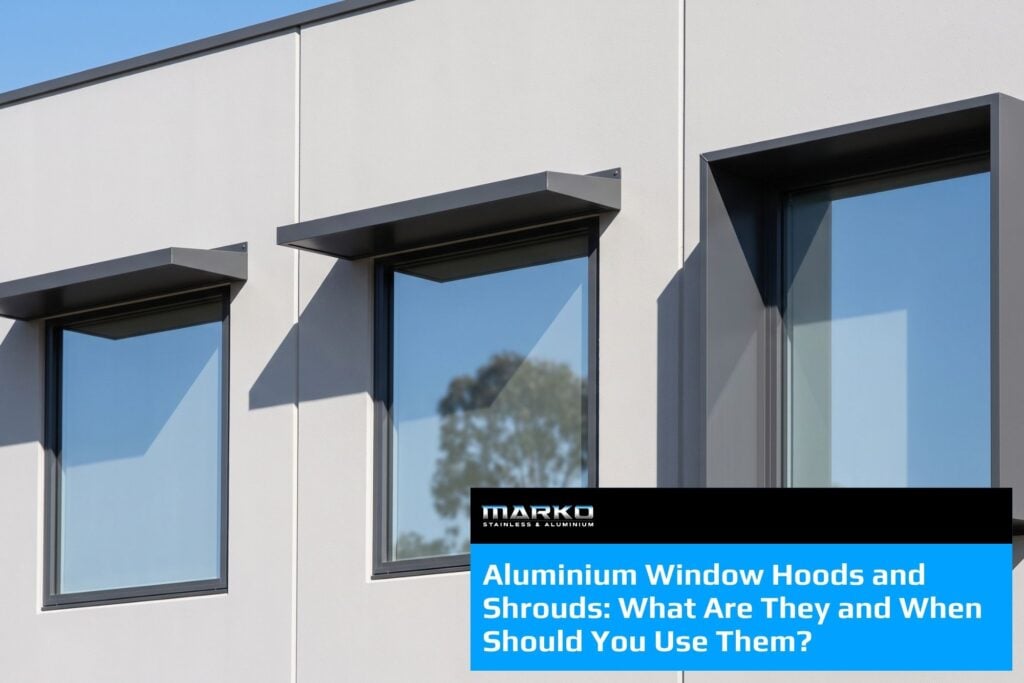
Aluminium window hoods and shrouds are external fabricated elements installed around windows to provide shade, cut weather exposure and add architectural definition.
A hood usually projects above the window, sometimes with short side returns. A shroud generally wraps the head and the sides, or the complete opening, to create a more enclosed frame. The two terms get used loosely between projects, so show the required shape on the drawings rather than relying on the word.
What is an aluminium window hood?
A window hood is typically a horizontal projection above the window. It shades the glazing, reduces direct rain at the head and creates a feature on the facade.
Projection, width and side returns all change how it performs. A shallow hood gives you architectural emphasis without much shade. A deeper hood shades more but generates larger wind loads and needs more serious fixings.
A hood does not replace window flashing, facade waterproofing or sealant detailing. It is an additional external element that has to be coordinated with the window and the wall system, not a substitute for either.
What is a window shroud?
A shroud has deeper returns around the opening. It may include a head, two sides and sometimes a lower section, which gives you a framed appearance.
Side panels help define the window, provide some privacy from angled views and add shading from lower-angle sun. Because a shroud covers more of the perimeter, it needs closer coordination with sills, drainage, cladding joints, window operation and maintenance access.
Hood versus shroud at a glance
| Consideration | Window hood | Window shroud |
| Typical form | Top projection with optional short returns | Head and deeper sides, sometimes a full frame |
| Visual effect | Horizontal emphasis | Framed, three-dimensional opening |
| Shading | Mainly from above | Overhead plus some angled shading |
| Coordination | Head flashing, fixings and projection | Head, sides, sill, drainage and window operation |
| Finish | Commonly powder-coated aluminium | Commonly powder-coated aluminium |
When should you consider one?
Solar control
A well-designed projection reduces direct sunlight reaching the glazing at certain times of day. How much depends on orientation, window size, sun angle and projection depth. A shallow hood that works on one elevation may do very little on another, particularly against low-angle morning and afternoon sun. Our earlier guide to window hoods and sun shades covers their broader role in external shading.
Weather exposure
A hood reduces direct rain reaching the top of the window. Side returns add some protection, but wind-driven rain will still reach the opening. The window and facade have to stay properly flashed and sealed regardless.
Privacy and screening
Deeper side returns restrict oblique views without blocking outward vision entirely. Check the required sightlines, daylight and window operation rather than assuming every shroud delivers the same privacy.
What needs to be specified?
Provide:
- window opening and frame dimensions
- overall hood or shroud dimensions
- top projection and side-return depth
- panel thickness and internal stiffening
- falls, drainage and drip details
- folded edges, end caps and corners
- fixing method and structural substrate
- relationship to flashings, cladding and sealants
- powder-coat colour, gloss and coating requirements
- site measurement and installation responsibility
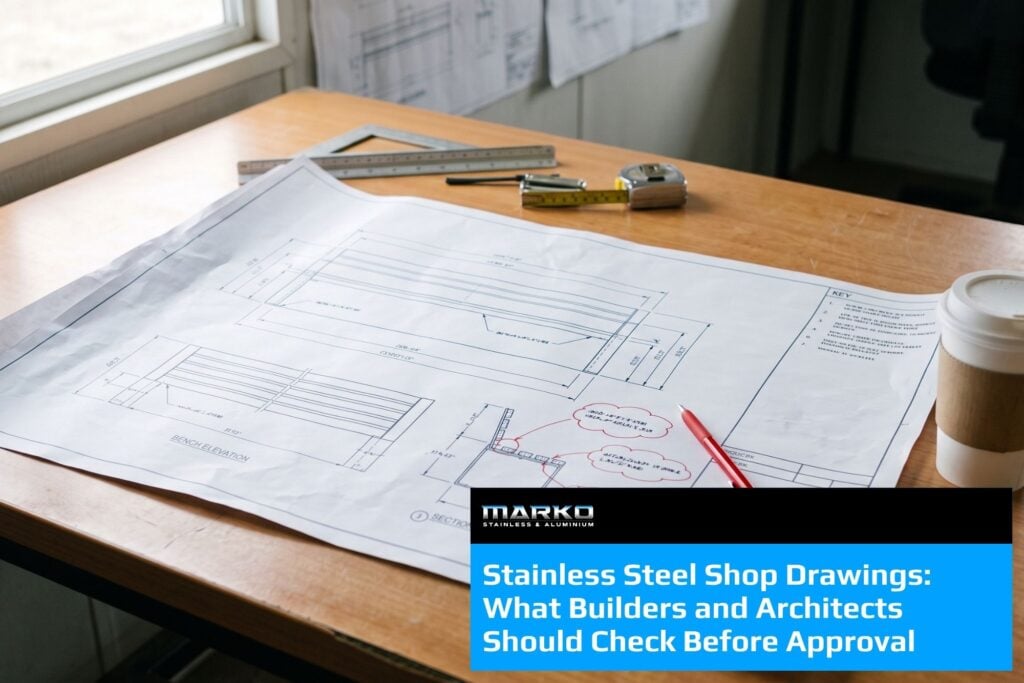
An elevation shows the appearance but rarely enough fabrication detail. Sections through the head, the sides and the sill are usually what explain projection, drainage and fixing.
How do orientation and projection affect performance?
The architect or building performance consultant should set the shading geometry. A horizontal top hood works better against high-angle sun than low-angle sun, so east and west facing windows often need deeper projections, side elements or a different shading approach altogether.
A deeper projection also puts more load through the fixings. Review the structural support and fasteners for the actual project rather than copying a detail from a smaller hood.
Plan water movement
Elements that look horizontal still need intentional falls and drainage. Water should not pond on the hood or run back toward the window.
Drip edges, ends and joints should move water away from the facade without staining it. Long hoods may also need planned panel joins and an allowance for thermal movement, since aluminium moves more than most people allow for across a long run.
Coordinate the fixings early
Aluminium is light, but an external hood picks up significant wind load because of its projection and surface area. Wind actions on building elements are covered by AS/NZS 1170.2, available through Standards Australia. Have the projection and fixings checked against the project wind classification rather than assuming a standard bracket will do.
Confirm whether the fixings connect to concrete, masonry, structural steel, timber framing or another engineered support. Cladding alone should not be assumed to carry it.
Fixings also have to be compatible with the aluminium and the adjoining materials. Dissimilar metals may need separation to reduce the risk of galvanic corrosion, which is worth attention on coastal Newcastle and Lake Macquarie jobs. Our guide comparing aluminium and stainless steel covers the broader material differences.
Allow for fabrication and installation
A large one-piece shroud gives you clean lines but can be difficult to transport, lift and install. Multi-part construction is often more practical, provided the joins are positioned deliberately rather than wherever the sheet ran out.
Verify dimensions at the right construction stage. Measure too early and you get discrepancies once windows, flashings and cladding are in. Measure too late and you hold up the program.
Specify the outcome, then resolve the detail
Use a hood where a top projection gives you the shading or the architectural effect you want. Use a shroud where side returns, stronger framing or additional screening matter.
Either way, performance comes from geometry, drainage, structure and facade coordination rather than from the aluminium itself. Our post on window hoods for commercial buildings covers the design side in more detail.
Marko Stainless & Aluminium fabricates custom powder-coated aluminium window hoods and shrouds at our Cardiff workshop for residential, commercial and architectural projects throughout Newcastle, Lake Macquarie, the Hunter and wider NSW.
Get in touch to discuss the dimensions, finish and fabrication requirements for your project.