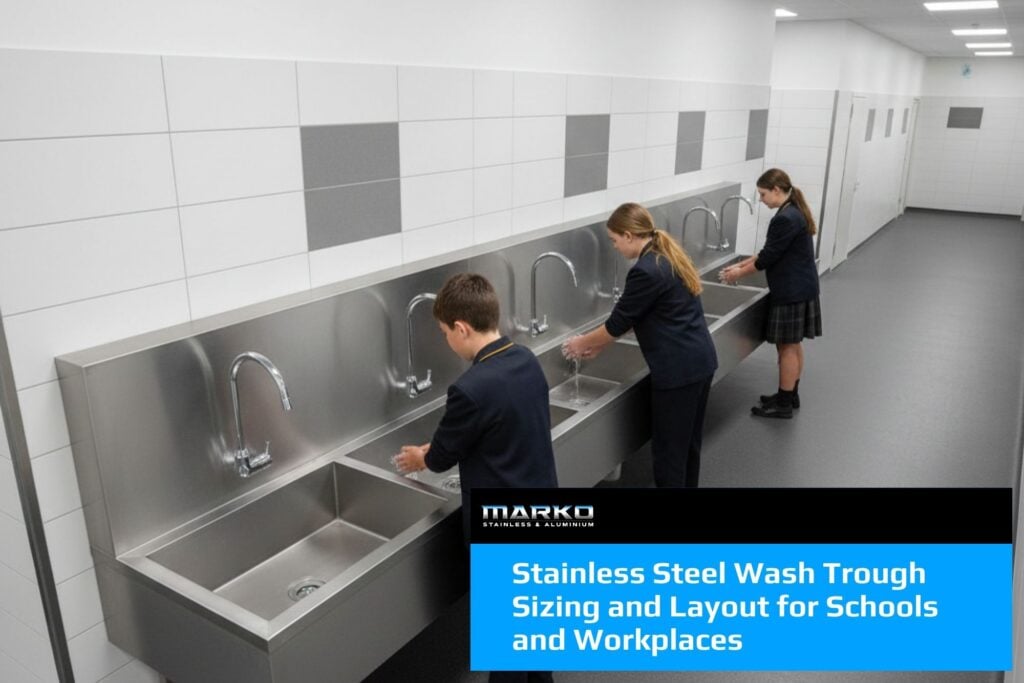
Wash troughs are a core fixture in schools, workshops, and commercial workplaces. When sized or laid out incorrectly, they can create congestion, hygiene issues, and long-term maintenance problems. Getting the sizing and spacing right from the start is essential to ensuring wash troughs perform efficiently in high-use environments.
At Marko Stainless & Aluminium, we fabricate stainless steel wash troughs designed to suit real-world use. By understanding common sizes, tap spacing, and layout considerations, builders and facility managers can specify troughs that work properly for their intended environment.
Why Correct Wash Trough Sizing Matters
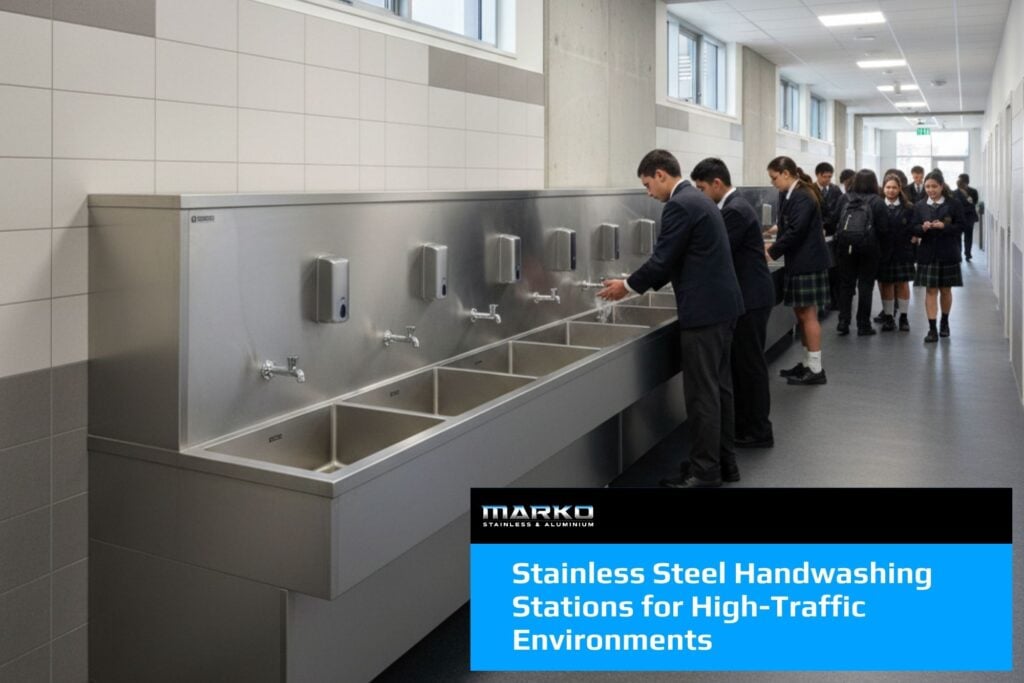
Wash troughs are often used by multiple people at the same time. If troughs are too short, too shallow, or poorly spaced, users quickly experience bottlenecks — particularly during peak periods such as school breaks or shift changes.
Correct sizing helps:
- Reduce congestion
- Improve hygiene outcomes
- Support efficient cleaning
- Extend the service life of the trough
Common Stainless Steel Wash Trough Lengths
In Australian education and commercial projects, several standard trough lengths are commonly specified:
- 1800 mm wash troughs
A popular option for smaller school bathrooms, staff amenities, and compact spaces. - 2400 mm wash troughs
One of the most commonly specified sizes, offering good capacity without excessive wall length. - 3000 mm and longer wash troughs
Typically used in busy schools, large workshops, and high-traffic workplaces where multiple users need simultaneous access.
Custom lengths beyond 3000 mm are often fabricated for particularly busy locations or where wall space allows.
Tap Spacing: Schools vs Workplaces
Tap spacing is just as important as overall trough length.
School Applications
In schools, tap spacing is commonly set at 400 mm centres. This spacing:
- Allows multiple students to use the trough comfortably
- Reduces splashing and overcrowding
- Supports efficient handwashing during peak times
Where required, school wash troughs can be fabricated to meet EFSG requirements, ensuring suitability for education environments.
Workshops and Commercial Workplaces
In workshops, factories, and commercial facilities, tap spacing is often wider than 400 mm. This allows:
- More space between users
- Accommodation for larger hands, gloves, or tools
- Improved comfort in industrial environments
Tap spacing should reflect how the trough will actually be used, not just how many taps can fit.
Depth and Splashback Considerations
Trough depth plays a role in both usability and cleanliness. Shallow troughs can lead to excessive splashing, while deeper troughs help contain water and reduce mess.
Integrated stainless steel splashbacks are commonly specified to:
- Protect walls from water damage
- Improve hygiene
- Simplify cleaning
Custom splashback heights can be fabricated to suit the installation environment.
Wall-Mounted vs Freestanding Layouts
Layout decisions also influence trough performance:
- Wall-mounted wash troughs
Ideal for indoor school bathrooms and corridors where floor cleaning efficiency is important. - Freestanding wash troughs
Common in workshops, outdoor areas, and retrofit installations where wall support may be limited.
Both options perform well when correctly designed for the site conditions.
Planning for Peak Usage
When sizing wash troughs, it’s important to plan for peak demand rather than average use. Schools and workplaces experience predictable surges in usage, and troughs should be designed to handle these periods without congestion.
Longer troughs with appropriate tap spacing help facilities operate smoothly during peak times.
Custom Stainless Steel Wash Trough Fabrication
Standard trough sizes work well in many cases, but custom stainless steel wash trough fabrication allows layouts to be optimised for each site. Customisation can include:
- Non-standard lengths
- Specific tap spacing
- Integrated soap and towel provisions
- Indoor or outdoor suitability
At Marko Stainless & Aluminium, troughs are fabricated to suit the space, user numbers, and environment rather than forcing a one-size-fits-all solution.
Stainless Steel vs Alternative Materials
Plastic and composite troughs often struggle in high-use environments. Stainless steel wash troughs offer:
- Superior durability
- Easy cleaning and hygiene
- Long service life
- Professional appearance
For schools and workplaces, stainless steel remains the preferred material.
Why Choose Marko Stainless & Aluminium?
- Real-world sizing experience: Troughs designed around actual usage patterns
- Custom fabrication capability: Lengths and layouts tailored to each site
- Education and workplace expertise: Understanding of high-traffic environments
- ASSDA accredited fabricator: Confidence in stainless steel workmanship
- Established since 1994: Proven reliability across Australian projects
Conclusion
Correct sizing and layout are critical to the performance of stainless steel wash troughs. By selecting appropriate lengths, tap spacing, and layouts for schools and workplaces, facilities can improve usability, hygiene, and long-term value.
By working with Marko Stainless & Aluminium, project teams can specify wash troughs that are designed to perform properly from day one.
Call to Action
Contact Marko Stainless & Aluminium to discuss stainless steel wash trough sizing and layout for your next school or workplace project.