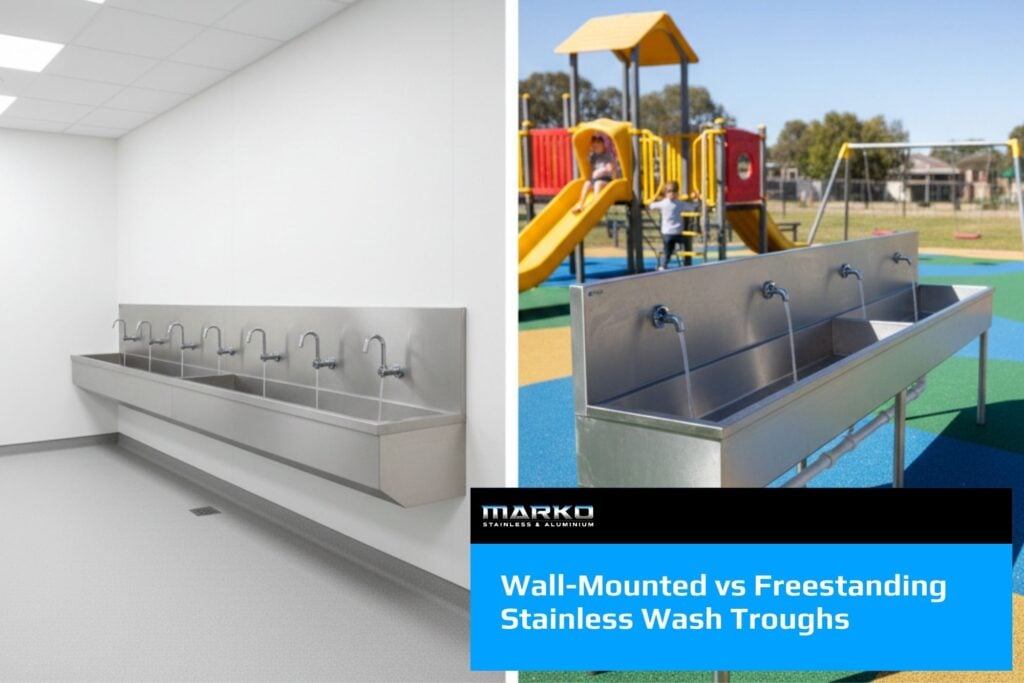
When specifying handwashing facilities for schools, workshops, and commercial buildings, one decision can have a big impact on installation, cleaning, and long term usability: should the wash trough be wall mounted or freestanding?
Both options perform well when designed and installed correctly. The right choice depends on site conditions, usage levels, and how the space needs to function day to day.
At Marko Stainless and Aluminium, we fabricate both wall mounted and freestanding stainless wash troughs, helping builders, architects, and facility managers choose the most practical solution for each environment.
What Is a Wall Mounted Stainless Wash Trough
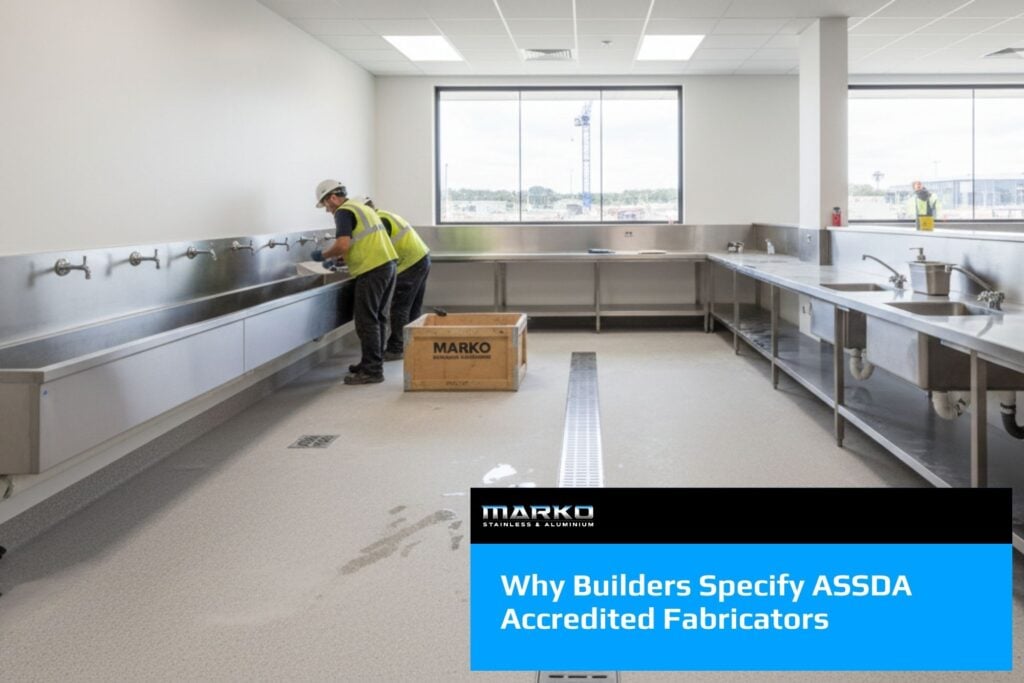
A wall mounted stainless wash trough is fixed directly to a structural wall, leaving the floor beneath clear. Plumbing connections are typically concealed within the wall cavity or run neatly below the trough depending on the building and services.
Common benefits include:
- Easier floor cleaning
- Reduced trip hazards
- Clean, streamlined appearance
- Efficient use of floor space
Wall mounted troughs are commonly specified in school corridors, indoor bathrooms, and compact amenity areas where cleaning efficiency and clear circulation are priorities.
What Is a Freestanding Stainless Wash Trough
A freestanding stainless wash trough is supported by legs or a frame, with plumbing typically concealed within the structure or left accessible where maintenance access is important.
Key advantages include:
- No reliance on wall structure
- Greater flexibility for placement
- Ideal for outdoor and retrofit installations
- Suitable where walls cannot support loads
Freestanding troughs are popular in outdoor handwashing areas, workshops, and retrofit applications where wall fixing is difficult or not practical.
Comparing Wall Mounted and Freestanding Troughs
Installation requirements
Wall mounted troughs rely on a suitable wall structure to support the weight of the unit, water load, and user interaction. In some buildings, additional wall reinforcement may be required, particularly for longer troughs or high use areas.
Freestanding troughs transfer load directly to the floor. This makes them a strong option where wall support is limited, unknown, or unsuitable.
Cleaning and maintenance
Wall mounted troughs make floor cleaning easier because there is clear space beneath the unit. This is especially useful in indoor school amenities and high hygiene areas where cleaning routines are frequent.
Freestanding troughs still allow effective cleaning, but may require extra attention around legs or frames and where services are run.
Flexibility and relocation
Freestanding wash troughs generally offer greater flexibility if layouts change in the future. Depending on plumbing, they can often be relocated more easily than wall mounted units.
Wall mounted troughs suit areas where the layout is stable and a fixed installation is preferred.
Which Trough Type Is Best for Schools
In schools, both options are used, depending on location and building conditions:
- Wall mounted troughs are common indoors where walls are strong and cleaning efficiency is important
- Freestanding troughs are often used outdoors, in playground areas, or where wall support is limited
In either case, trough length and tap spacing should suit student numbers and usage patterns to avoid congestion during peak times.
Workshops and Commercial Applications
In workshops and commercial environments, freestanding troughs are often preferred because they offer:
- Easier installation in varied wall conditions
- Flexibility around services and fitouts
- Suitability for heavy duty use and accessible maintenance
Wall mounted troughs can still be a good fit where space efficiency and easy cleaning are priorities, particularly in indoor staff amenities and compact utility zones.
Custom Stainless Wash Trough Fabrication
One of the strengths of stainless steel is how adaptable it is to real site needs. Custom stainless wash troughs can be fabricated as wall mounted or freestanding units with:
- Custom lengths and depths
- Specific tap spacing
- Integrated splashbacks
- Options suited to indoor or outdoor environments
At Marko Stainless and Aluminium, we fabricate troughs to suit the site requirements rather than forcing a standard configuration into a space that does not quite work.
Stainless Steel vs Alternative Materials
Plastic and composite troughs can struggle in high use environments. Stainless steel wash troughs offer:
- Impact resistance
- Long service life
- Easy cleaning and strong hygiene performance
- A professional appearance that holds up over time
For schools and commercial projects, stainless steel remains a preferred choice for durability and lifecycle value.
Why Choose Marko Stainless and Aluminium
- Flexible fabrication options: Wall mounted or freestanding troughs to suit site conditions
- Design support: Practical advice on trough type, sizing, and layout
- Built for installation: Fabrication aligned with plumbing and site constraints
- ASSDA accredited fabricator: Confidence in stainless steel workmanship
- Established since 1994: Experience delivering reliable wash trough solutions
Conclusion
Choosing between wall mounted and freestanding stainless wash troughs comes down to installation conditions, cleaning priorities, and long term flexibility. Both options can deliver excellent performance when fabricated correctly and installed in the right environment.
By working with Marko Stainless and Aluminium, builders and facility managers can select the right wash trough solution with confidence.
Call to Action
Contact Marko Stainless and Aluminium today to discuss wall mounted or freestanding stainless wash troughs for your next project.