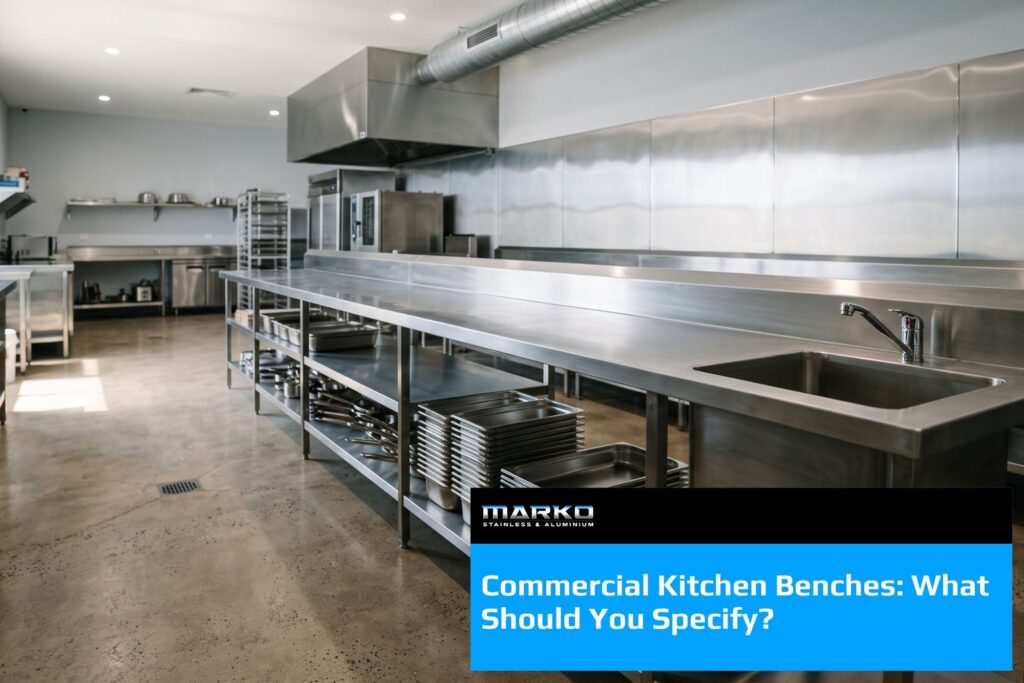
Ordering a stainless steel bench for a commercial kitchen takes more than a length and a width. Construction method, sink arrangement, splashbacks, shelving, finish and the way the bench meets the rest of the room all change the result you get.
Marko Stainless & Aluminium manufactures commercial stainless steel benches and countertops for restaurants, clubs, schools, canteens, healthcare facilities and other high-use environments. We are also seeing architects specify solid plate stainless steel benchtops more often, particularly where appearance, custom detailing and an all-stainless build matter.
The time to work through these details is before fabrication starts.
The short answer
Before ordering a commercial kitchen bench, you should know:
- the overall dimensions
- how the bench will be supported
- folded or solid plate benchtop
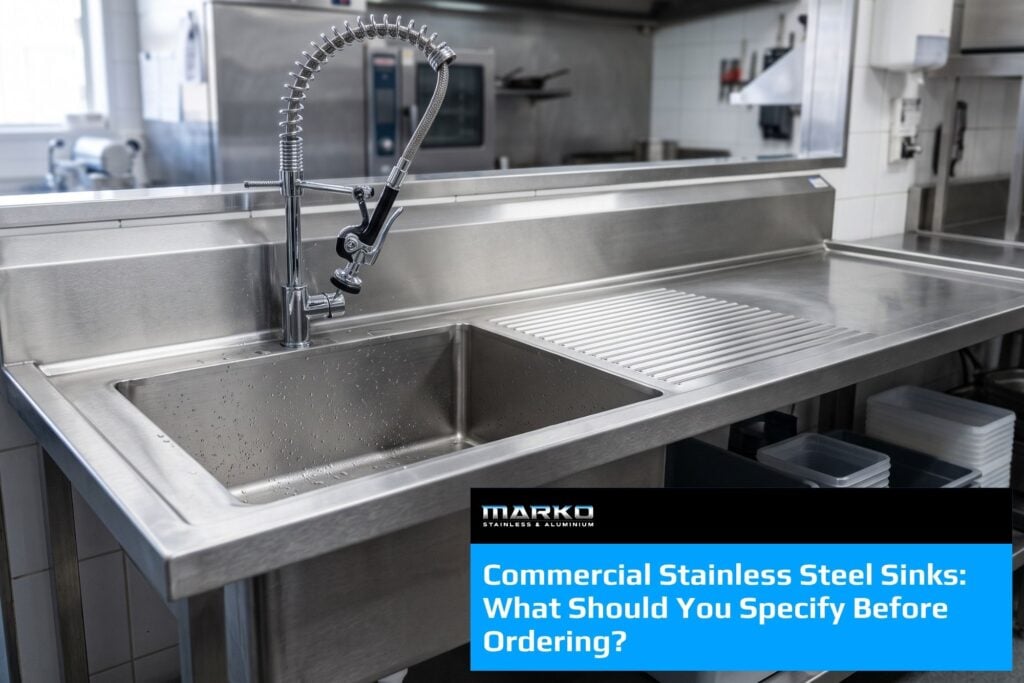
- sink type, size and position
- splashback and upstand requirements
- shelving or cabinet requirements
- equipment and appliance cut-outs
- the preferred stainless steel finish
- how the bench meets walls, joinery and other equipment
Settle those early and you get a bench that fits the space and works once the kitchen is running.
Start with how the bench will be used
A preparation bench, a wash-up bench and a cooking-line bench can look almost identical on a drawing. They do very different jobs.
Think about what happens at the bench every day. Will staff be preparing food? Washing large pots? Loading a dishwasher? Running appliances? Moving hot equipment? Working from both sides?
The intended use drives depth, height, sink arrangement, splashback, shelving and construction. A commercial kitchen bench should be designed around the workflow, not around whatever gap is left in the room.
Folded benchtop or solid stainless steel plate?
This has become the specification decision that changes the most downstream.
A conventional commercial benchtop is usually fabricated from about 1.2mm to 1.5mm stainless steel, folded to form the edges and bonded to a substrate for support. Folded substrate benchtops still suit a wide range of commercial kitchens and remain the practical option on most jobs.
The alternative, specified more often by architects, is a solid stainless steel plate benchtop. Marko fabricates these from 4mm to 10mm plate, and 6mm is the common choice for commercial and architectural work.
| Folded substrate benchtop | Solid plate benchtop |
| Typically 1.2mm to 1.5mm stainless steel | Typically 4mm to 10mm plate, commonly 6mm |
| Folded and supported by a substrate | Solid stainless steel, no bonded substrate |
| Suits most standard commercial applications | Suits architectural and highly customised work |
| Normally supplied in a directional brushed finish | Brushed or orbital finish available |
| Sinks can be incorporated | Integral welded, undermount and top-mount sinks available |
Neither build is automatically better. The right choice comes down to the design, the budget, the appearance you want and how the top gets used. If the terminology is tripping up the drawings, our post on the difference between stainless steel benches and benchtops sorts it out.
Specify the sink arrangement early
If the bench carries a sink, resolve the sink details before fabrication. Useful information includes:
- bowl dimensions
- bowl depth
- number of bowls
- left, right or centre position
- tap locations
- draining areas
- dishwasher or equipment interfaces
Solid plate tops open up more options here. Sinks can be integrally welded into the top for a continuous fabricated appearance, or the plate can take undermount or top-mount bowls, depending on the design.
Planning the sink at the same time as the benchtop nearly always beats treating it as a separate item later.
Do not forget splashbacks and upstands
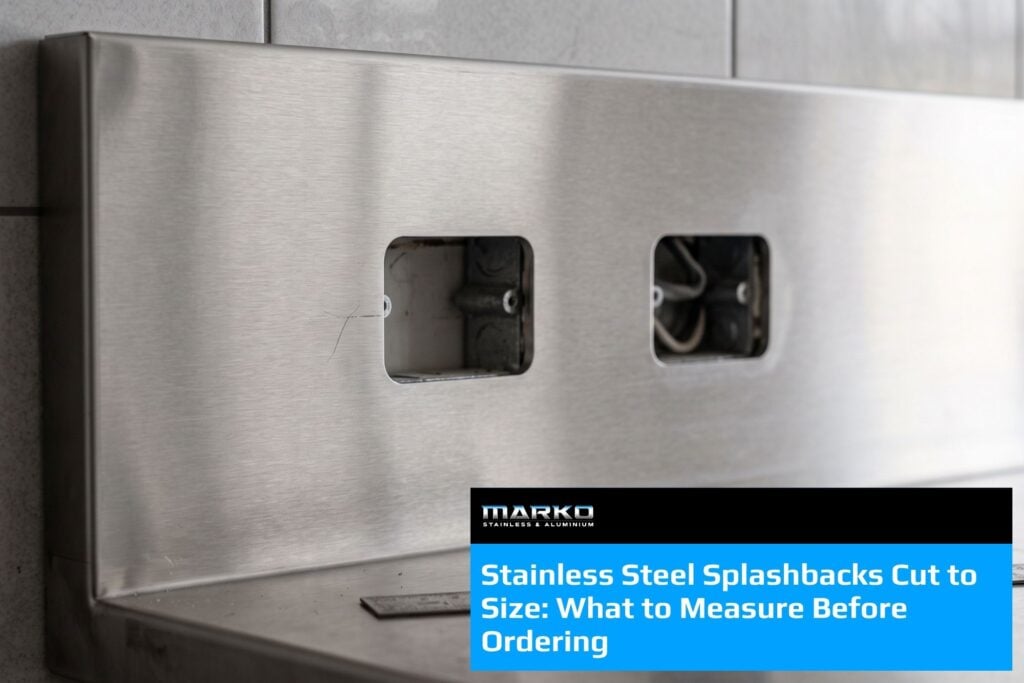
The relationship between the benchtop and the wall should be clear on the drawings. Depending on the application, the bench may need no upstand, a small perimeter upstand, a full-height rear splashback, end splashbacks, or returns around adjoining walls.
These details affect cleaning, water control and how neatly the finished bench meets the building. Coordinate them with wall linings, power outlets, taps and other services.
Standard 3.2.3 of the Australia New Zealand Food Standards Code covers fixtures, fittings and equipment in food premises, including surfaces that need to be able to be cleaned effectively. Check the FSANZ food safety standards alongside the project specification when the bench sits in a food handling area.
Think about equipment before the bench is made
Cooktops, dishwashers, refrigerators and other equipment change how a bench gets built.
Solid plate tops can be fabricated with accurately positioned cut-outs for cooktops and other equipment. Folded benches can be customised around equipment too, but the clearances and support need working out from the start.
Send equipment specifications or shop drawings early. It saves site modifications after the bench is already made.
Choose the finish to suit the project
Brushed stainless steel is still a popular, practical finish for commercial benches.
For solid plate tops, orbital is currently the most requested finish at Marko Stainless & Aluminium. Instead of a traditional directional grain, an orbital finish creates a randomised surface pattern. It gives a distinctive architectural look and suits large exposed plate surfaces.
Agree the finish before fabrication. It becomes a permanent part of the appearance.
Specify what goes under and above the bench
The benchtop is only part of the job. Depending on workflow, you may need:
- no undershelf
- a single undershelf
- a double undershelf
- lockable under-bench cabinets
- single-tier above-bench shelving
- double-tier shelving
- shelving built to carry heat lamps
These choices change how useful the finished workstation is more than most people expect.
Solid plate also gives a different end-of-life option
An all-stainless solid plate benchtop does not rely on a bonded substrate.
At the end of its service life the stainless steel can be recovered and recycled, rather than dealing with stainless permanently bonded to another material. For architects and clients thinking about material selection and future resource recovery, that is another point in favour of solid plate.
Why choose Marko Stainless & Aluminium
Marko Stainless & Aluminium has been fabricating stainless steel since 1994 and works with builders, architects, commercial kitchens, schools and other project teams across NSW from our Cardiff workshop.
Our commercial bench capability covers folded stainless steel benches and benchtops, solid plate benchtops, orbital and brushed finishes, integral welded, undermount and top-mount sinks, custom sink bowls, appliance and cooktop cut-outs, splashbacks and upstands, undershelves, cabinets and above-bench shelving, and custom fabrication to architectural drawings or site measurements.
As an ASSDA accredited fabricator we can also work through material and fabrication questions with you while the solution is still being developed.
Get the specification right first
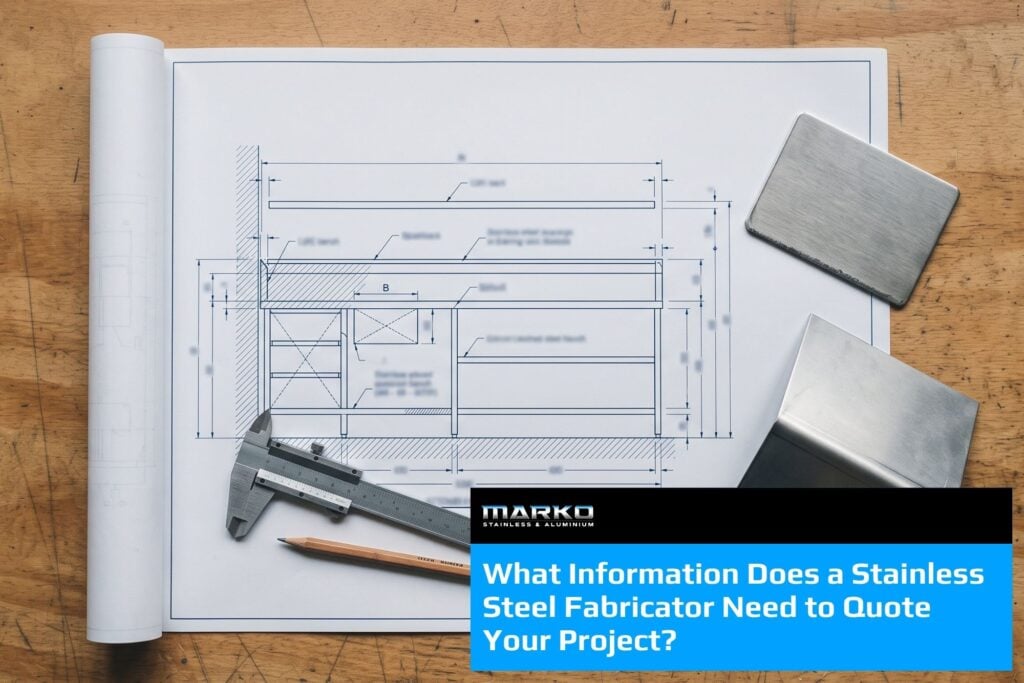
A good commercial kitchen bench starts with a clear specification. Rather than picking a generic stainless bench and bending the kitchen around it, work out how the bench will be used, what equipment it has to carry, how sinks and splashbacks integrate, and whether folded or solid plate construction fits the job.
Sorting that before fabrication gives you a cleaner installation and a bench that suits the way the space runs. Send us your drawings to discuss custom commercial kitchen benches, stainless steel benchtops or solid plate benchtops for your next project.