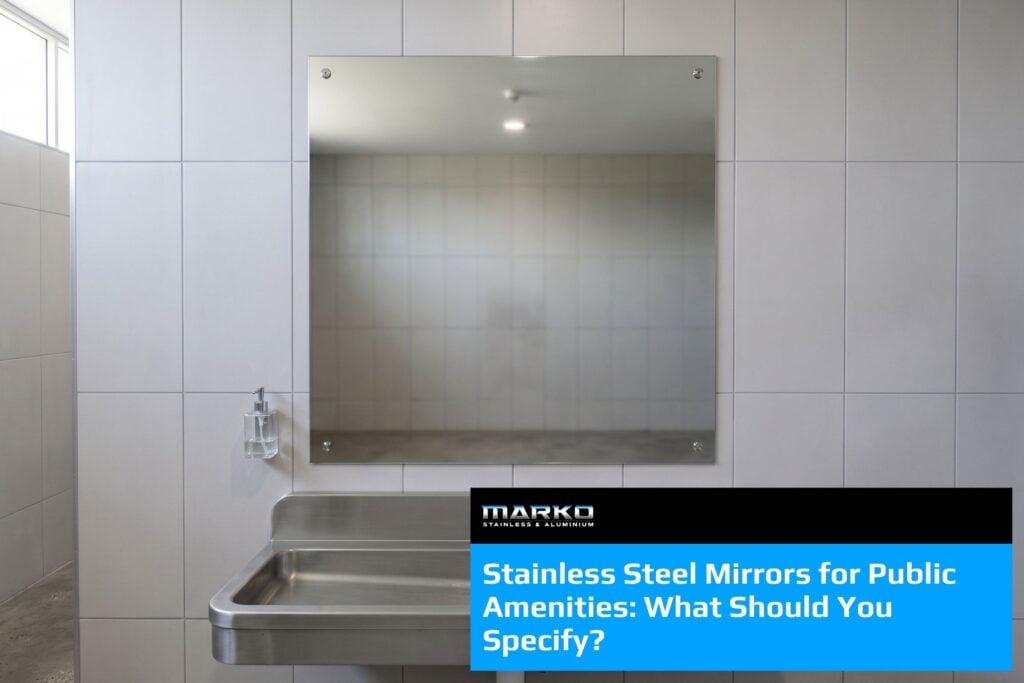
A stainless steel mirror specification should cover more than width and height. It needs to state the construction, the reflective finish, the edge treatment, the fixing method, the mounting location and the exposure conditions.
Those details drive appearance, cleaning, installation and how well the mirror stands up to misuse. They also let the mirror be built around the actual wall and the surrounding fixtures, instead of being treated as a generic item bolted on at the end of the job.
Why use stainless steel in public amenities?
Public bathrooms, school amenities, sporting facilities and council buildings cop constant use, frequent cleaning and the occasional bit of vandalism. A polished stainless steel mirror gives you a reflective surface without a fragile glass panel behind it.
That does not mean every stainless mirror gets specified the same way. A supervised staff bathroom has nothing in common with an external public amenity or an unsupervised school change room.
Our comparison of stainless steel and glass mirrors in public amenities covers the material choice itself. Once stainless is settled, these are the details that still need resolving.
Confirm the finished size
Give the finished width and height rather than a note saying “mirror over basin”. The mirror has to relate to the basin or trough layout, the wall joints, the dispensers, the lighting and the other accessories.
For multiple basins, decide between one continuous mirror and separate units. A continuous mirror gives you a clean visual line, but its size affects handling and installation.
Check the delivery path while you are at it. A mirror that fits the wall can still be a problem to get through completed corridors and doorways.
Select the mirror construction
Marko Stainless & Aluminium manufactures two standard models, and they are built differently. The M2.0 mirror is 2.0 mm stainless steel with softened edges and fixing holes. The MT mirror is a 1.0 mm stainless face bonded to a 12 mm HMR substrate, with fully welded and polished corners, in stock sizes of 575 x 575 mm, 600 x 600 mm and 1000 x 450 mm. Custom sizes are available in both.
That substrate is the decision that matters most. The M2.0 is all stainless steel. The MT carries a moisture-resistant board behind the face, which gives it rigidity and a neat fabricated edge, but it is a different product for a different location.
Show the selected model on the mirror schedule. Calling up a “stainless steel mirror” and nothing else leaves the fabricator guessing at a real design decision.
Nominate the reflective finish
A working stainless steel mirror needs a highly polished reflective face. Both Marko models use a No.8 super mirror finish in 304 Grade, with 316 Grade available on request.
The reflected image is not identical to conventional glass, particularly across large sheets or where the supporting wall is uneven. Think about the viewing distance and the intended use.
Stainless mirrors suit general grooming and handwashing areas where durability and shatter-resistant construction come first. If there is a specialised optical or clinical requirement, say so rather than assuming it will be covered.
Detail the edges and corners
Edge treatment changes both the appearance and how the mirror meets the wall.
For the M2.0, confirm whether the softened edges stay visible and how the panel gets fixed. For the MT, the welded and polished corners give you a completed fabricated form without separate corner components, and the substrate depth becomes part of the profile.
Mirrors installed tightly between finished surfaces need realistic tolerances. Do not set out on the assumption that every wall is straight and square.
Coordinate the mounting method
Identify the wall construction and the fixing arrangement. Concrete, masonry, fibre-cement sheet and framed walls are not interchangeable when it comes to holding a mirror up.
Where tamper resistance matters, fixings should make removal difficult and keep exposed components to a minimum. The substrate has to support the mirror evenly, because poor backing or overtightened fixings will show up as distortion in the reflection.
Confirm who is responsible for site measurement, backing, drilling, sealants and final installation before you order.
Consider the environment
Internal amenities, external toilet blocks, swimming facilities and coastal locations are all different exposure conditions. Tell the fabricator whether the mirror sits indoors, outdoors, near the coast or in an area that gets hosed down.
This is where construction and environment meet. A substrate-backed mirror behaves differently from an all-stainless panel in a wet or externally exposed location, so raise the exposure conditions early and let the fabricator recommend the model rather than picking one off a stock size.
Fixing compatibility matters too. Unsuitable metals against stainless steel can contribute to staining or corrosion around the installation.
Set out the mounting location
Give a clear mounting height, or a relationship to the basin, benchtop or wash trough. Account for tapware, splashbacks, dispensers, hand dryers, lighting and signage.
Where several mirrors go in, use a consistent datum unless the drawings say otherwise.
Accessibility requirements are the architect’s call, not the fabricator’s. Part F4 of the National Construction Code covers sanitary and other facilities and picks up the accessibility provisions that apply to public amenities. Have the architect or access consultant confirm mounting heights against the project requirements before the schedule is issued.
What should accompany the quote request?
A useful mirror enquiry includes:
- quantity and finished dimensions
- M2.0, MT or custom construction
- No.8 super mirror finish, and 304 or 316 Grade
- edge and corner requirements
- wall construction and fixing expectations
- installation location and environmental exposure
- site measurement and installation scope
- drawings showing adjacent fixtures and finishes
Providing this early cuts the assumptions out of quoting, shop drawing and fabrication.
Specify the complete mirror
A good specification pulls together size, construction, finish, edges, fixings and location. The right answer depends on how the room gets used and what it is exposed to.
Marko Stainless & Aluminium manufactures stainless steel mirrors in Cardiff for schools, builders and public projects throughout Newcastle, the Hunter, NSW and across Australia. We have fabricated stainless steel since 1994 and are an ASSDA accredited fabricator.
Get in touch to discuss stainless steel mirrors for your public amenity project.