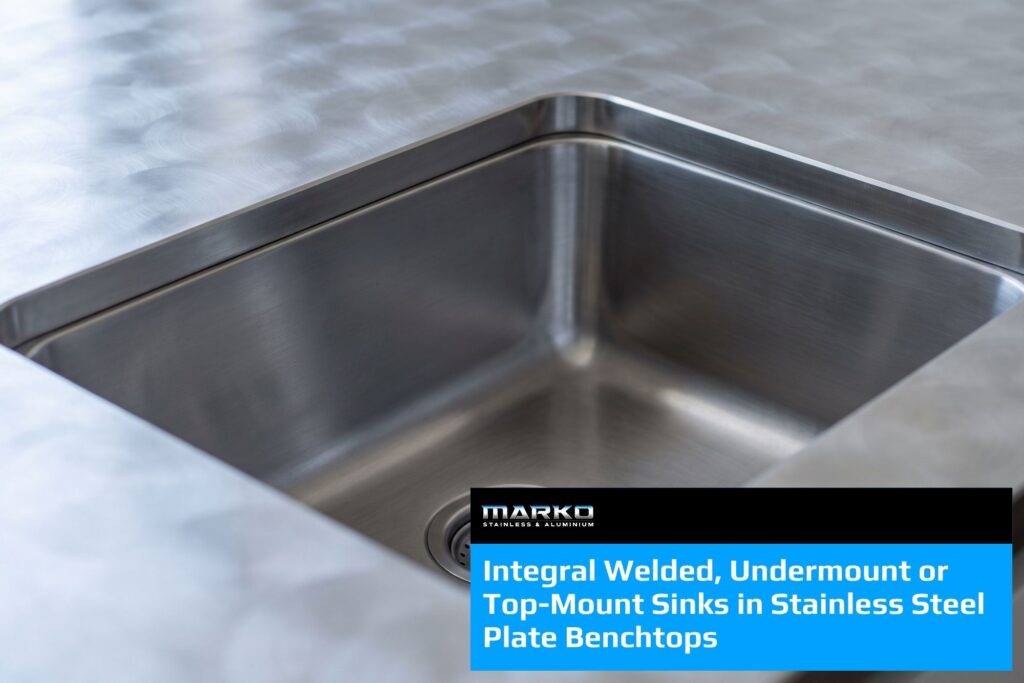
Integral welded, undermount and top-mount sinks can all go into a solid stainless steel plate benchtop, but they create different edges, joints and installation requirements.
An integral welded bowl gives you the most continuous fabricated result. An undermount sink keeps its rim below the work surface. A top-mount sink sits on top of the plate. Which one suits comes down to use, appearance, cleaning, the sink model you have selected, the budget and how you expect to get at it in ten years.
Quick comparison
| Sink arrangement | Appearance | Main advantage | Main consideration |
| Integral welded | Bowl and top form one fabricated assembly | Continuous detail with no surface rim | Needs early decisions and more fabrication |
| Undermount | Rim concealed below the plate | Clean look with the solid plate edge on show | Edge finishing, sealing, support and access |
| Top-mount | Rim visible above the plate | Straightforward use of proprietary sinks | Raised rim and seal interrupt the surface |
What is an integral welded sink?
An integral sink is a stainless steel bowl fully welded into the plate benchtop. The joint is fabricated and finished so the bowl and the top read as one continuous detail.
It gets selected for architectural kitchens, bars, serveries and high-end fitouts where the sink is meant to look like part of the benchtop. It removes the surface rim and the sealant line that come with a top-mount.
Depending on the size and shape you need, either a pressed or a fabricated bowl can be integrated into the plate. Our guide to pressed and fabricated stainless steel sink bowls covers that separate decision.
Integral welding gives you design freedom, but bowl dimensions, depth, position, corner radii, waste, overflow, tapware and drainer details have to be confirmed early. Replacing an integral bowl later is a bigger job than swapping out a proprietary sink.
How does an undermount sink work with solid plate?
An undermount sink is fixed beneath the plate. The cut edge of the solid stainless steel stays visible around the opening, which puts the plate thickness on display. On a 6 mm top that reveal is part of the look.
This suits projects that want an architectural finish while keeping a selected proprietary sink. The exposed stainless edge gets finished as part of the benchtop.
Undermounting is more than cutting a hole and hanging the sink off it. The fabricator needs the exact manufacturer, model and current template to coordinate:
- cut-out dimensions and corner radii
- the reveal you want around the bowl
- flange width and fixing method
- sealant joint and sink support
- installation and future removal access
The sink, the water and whatever gets stacked in it all add load. Support it properly rather than relying on sealant.
When is a top-mount sink appropriate?
A top-mount or drop-in sink passes through the opening and rests on its rim above the surface. It is usually the most straightforward way to use a proprietary sink.
Top-mounts are practical in staff and service areas where function, availability and easy replacement matter more than a continuous architectural surface.
The trade-off is the raised rim. Water and debris cannot be wiped straight into the bowl, and the perimeter seal becomes part of the cleaning routine and eventually part of the maintenance schedule.
Plate thickness also has to be checked against the sink clips and fixing system. Components designed for thinner benchtops will not always take 6 mm stainless steel plate. Marko fabricates plate tops from 4 mm to 10 mm, so confirm the actual thickness with the sink manufacturer, not a nominal one.
How does this differ on a folded benchtop?
On a folded substrate benchtop, the top is typically 1.2 mm to 1.5 mm stainless folded and bonded to a substrate. Sinks are normally welded in or dropped in, and there is no thick plate edge to show off around an undermount opening.
That is the practical reason this decision belongs to plate tops. If you are still choosing between folded and plate construction, settle that before you settle the sink.
Does the sink choice affect support?
Yes. A solid plate benchtop is heavier than a folded top, and a sink opening takes material out of the plate. The sink and its contents add more load again.
Cabinetry, frames, brackets, spans and local support around the opening should all be reviewed together. Solid plate is not automatically self-supporting because it happens to be thicker.
Access matters too. Deep bowls and undermount supports will happily collide with drawers, cabinet rails, appliances and plumbing underneath.
Cleaning and food safety
In food handling areas, the sink detail is a hygiene detail. Standard 3.2.3 of the Australia New Zealand Food Standards Code requires fixtures, fittings and equipment to be able to be cleaned effectively. An integral welded bowl removes the rim and the sealant joint that a top-mount creates, which is why it gets specified in commercial kitchens even where the budget is tight. Check the FSANZ food safety standards alongside the project specification.
That does not rule out top-mount sinks in food areas. It means the seal becomes something the venue has to maintain, so it needs to be reachable and it needs to be in the cleaning schedule.
What should be decided before fabrication?
Confirm:
- exact sink manufacturer, model and current template
- integral welded, undermount or top-mount installation
- bowl dimensions, depth and position
- cut-out, reveal and corner details
- tap and accessory holes
- waste, overflow and plumbing requirements
- drainers, falls or grooves where required
- cabinetry, support and access below
- brushed or orbital benchtop finish
An online product description without the current technical template is not enough. Small differences between sink models change the cut-out and the fixing arrangement, and the plate is already cut by the time anyone notices.
Frequently asked questions
Can any proprietary sink be undermounted into 6 mm plate?
No. The flange, geometry, fixing system and available support all have to suit. Review the exact model before the plate gets cut.
Can an undermount sink be replaced later?
Potentially, provided the fixings, sealant and plumbing stay accessible and a compatible replacement is still available. Think about it during the original design rather than after.
Is an integral welded sink always the best option?
No. It gives you a continuous custom result, but it costs more to fabricate and is harder to replace. An undermount or top-mount may suit the budget and the maintenance strategy better.
Choose the sink and benchtop as one system
The sink arrangement changes the benchtop edge, the cut-out, the support, the cleaning and the installation. Pick it while the plate top, the cabinetry and the services are still being coordinated, not after.
Marko Stainless & Aluminium provides custom stainless steel fabrication for solid plate benchtops with integral welded, undermount and top-mount sink options. From our Cardiff workshop we supply architectural and commercial projects throughout Newcastle, the Hunter, NSW and across Australia.
Send us your drawings to discuss sink integration and solid plate benchtop requirements for your project.