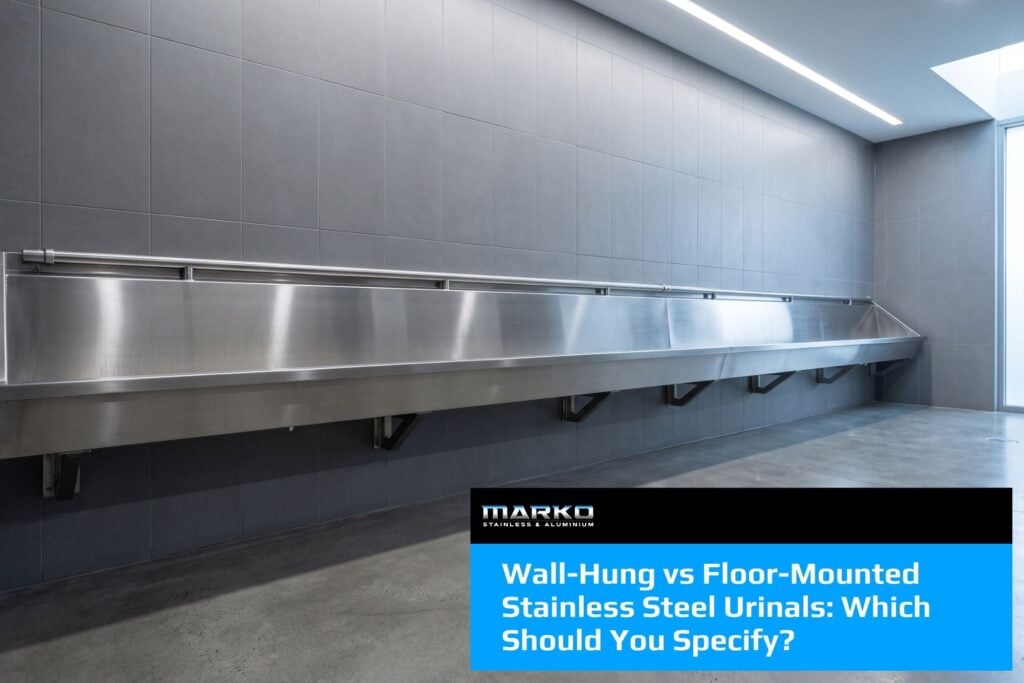
A wall-hung stainless steel urinal is mounted clear of the floor. A floor-mounted urinal runs down to the floor. Wall-hung units give you open cleaning access underneath but need suitable wall structure and coordinated fixings. Floor-mounted designs give you a substantial installation for long, high-use layouts but need closer coordination with floor finishes, waterproofing and cleaning.
Neither is automatically better. The answer depends on the room, the substrate, the urinal length, the expected use, the plumbing, the cleaning method, and new build versus refurbishment. Our stainless steel urinals and cisterns range covers all three configurations.
Comparison at a glance
| Consideration | Wall-hung urinal | Floor-mounted urinal |
| Floor cleaning | Open access beneath the fixture | Floor junction has to be detailed |
| Structural support | Relies on wall backing and fixings | Supported at floor level, still coordinated with the wall |
| Long lengths | Available to 6000 mm, subject to support | Available to 5500 mm, well suited to multi-user layouts |
| Refurbishment | Useful where the wall and existing services suit | May suit existing floor-based arrangements |
| Main coordination | Wall structure, fixings and services | Floor falls, waterproofing, waste and junctions |
When does a wall-hung urinal make sense?
A wall-hung trough keeps the floor visible below the fixture. That makes it easier to clean underneath and removes a continuous front junction where grime and moisture collect.
It suits schools, workplaces, commercial amenities and public facilities where clear floor access is a maintenance priority. The Marko W621 wall-hung urinal is available from 600 mm to 6000 mm, with custom lengths, site joins on request, and left, centre, right or custom outlet positions.
The main requirement is adequate wall support. The completed unit, the plumbing and the loads created during use all have to transfer safely into the building structure. Do not assume lightweight wall lining will do it.
The drawings should identify:
- wall construction and structural backing
- urinal length and mounting height
- bracket and fixing locations
- left, centre, right or custom outlet
- flushing arrangement and cistern location
- access to wastes, pipes and serviceable components
Resolve these before wall framing and hydraulic rough-in are finished. Adding backing after the walls are lined is avoidable cost and avoidable delay.
When is a floor-mounted urinal suitable?
Floor-mounted options cover slab and step-style stainless steel urinals. They get used for long, high-capacity installations in schools, sports facilities, stadium amenities, industrial sites and public buildings.
The Marko S621 slab urinal and D621 deluxe step urinal are both available from 900 mm to 5500 mm, with custom lengths, site joins and corner units on request, and left, centre, right or custom outlets.
A floor-mounted unit often suits a refurbishment where an existing slab-style fixture is being replaced and drainage is already set at floor level. It also suits new amenities that need a continuous run.
The floor junction is where these jobs go wrong. Coordinate:
- finished floor level and falls
- waterproofing termination
- floor and wall finishes
- waste penetrations
- sealant and perimeter junctions
- cleaning access at ends and corners
- installation sequence
Small variations in floor level become obvious across a 5 metre stainless unit. Final site measurements may be needed once substrates and finishes are far enough along.
Which option is easier to clean?
Wall-hung urinals generally give better access to the floor beneath, which makes routine mopping or washdown quicker. The underside, the brackets and the wall junction still have to be reachable and properly finished.
Floor-mounted urinals remove the open area underneath but add junctions along the floor and sometimes at the ends. Those details should keep ledges and inaccessible gaps to a minimum.
Treat cleaning as a design input rather than claiming one model is always more hygienic. Staff need access to the stainless steel, the floor, the corners, the outlets and the surrounding surfaces, and that is a layout question as much as a fixture question.
How do plumbing and flushing affect the choice?
Confirm the cistern or flushing system, the flush pipes, the waste position and the maintenance access before fabrication. Marko can supply cisterns to suit the project.
Concealed cisterns give you a clean appearance, but access panels and future servicing still need planning. Exposed systems are easier to inspect but need coordination of visible pipework and some thought about security in unsupervised amenities.
Check WaterMark requirements against the nominated product and the complete plumbing assembly. WaterMark certification is administered by the Australian Building Codes Board and is required under the Plumbing Code of Australia for certain plumbing and drainage products. One compliant component does not automatically cover every connected item, so have the hydraulic consultant confirm the assembly.
What about long urinals and site access?
The largest unit that can be manufactured is not always the largest unit that can be installed. Check corridors, doors, corners, stairs and lifting access.
Long urinals may need site joins, and the join positions should account for appearance, support, sealing and plumbing. Corner units need accurate site dimensions, because building corners are rarely as square as the drawings suggest.
For more on when longer installations make sense, see our guide to stainless steel urinal troughs for schools and sports facilities.
What should the specification include?
Provide:
- wall-hung, slab or step-style model
- overall length and room dimensions
- stainless steel grade and finish
- mounting height and support details
- outlet, flushing system and cistern
- service access
- floor, wall and waterproofing details
- corner configuration or site joins
- delivery path and installation responsibility
Marko manufactures all three models from 304 Grade No.4 finish stainless steel, with 316 Grade available on request where the environment calls for more corrosion resistance.
Choose from the room outward
Review the wall structure, floor construction, services, cleaning, security, access and installation sequence together. Picking a urinal on appearance alone just hands the unresolved problems to the builder and the plumber.
Marko Stainless & Aluminium manufactures stainless steel urinals and cisterns at our Cardiff workshop. As an ASSDA accredited fabricator established in 1994, we supply builders, schools and commercial projects throughout Newcastle, the Hunter, NSW and across Australia.
Talk to us about the most suitable stainless steel urinal arrangement for your project.