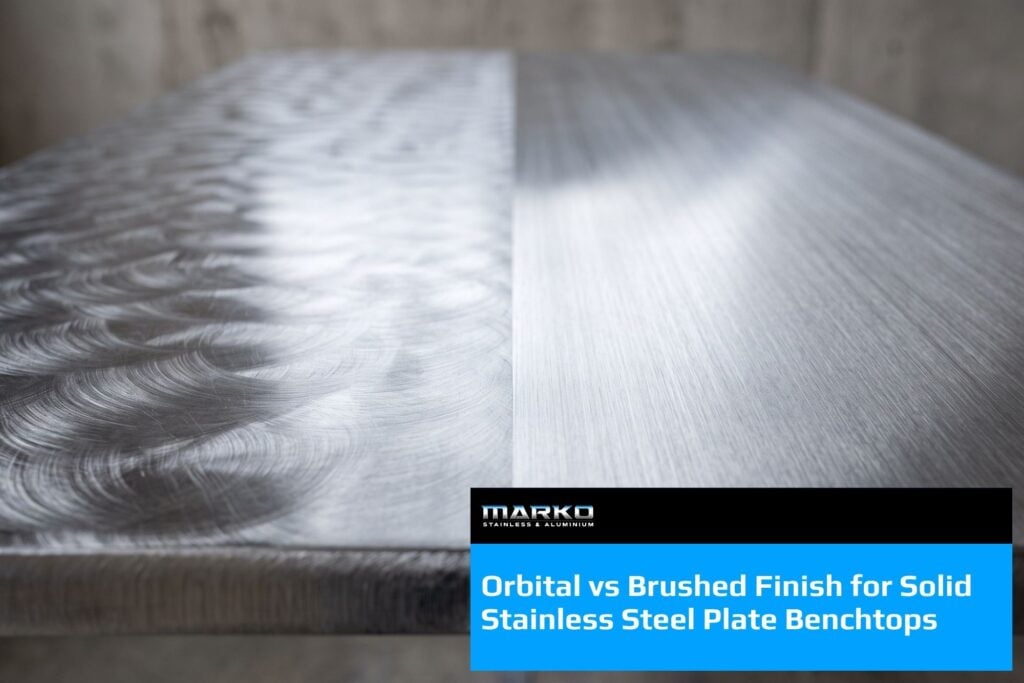
For a solid stainless steel plate benchtop, the choice between orbital and brushed comes down to appearance, grain direction and how the surface will look once it picks up normal working marks.
A brushed finish gives you a consistent linear grain. An orbital finish gives you an overlapping, non-linear pattern with no dominant direction. Both produce an architectural-quality benchtop. Across a large plate surface they look noticeably different.
At Marko Stainless & Aluminium, orbital is currently the most popular finish for solid plate benchtops. Its random pattern suits the visual weight of a 6 mm plate top and tends to make everyday marks less dominant.
What is a brushed stainless steel finish?
A brushed or No.4-type finish has visible polishing lines running in one direction. ASSDA describes No.4 as a directional, low-gloss finish used widely on work surfaces and where appearance matters.
On a benchtop, the grain direction has to be maintained across the top, the exposed edges, adjoining sections and any fabricated details.
A brushed finish is often the better call when:
- other stainless steel in the room has a linear finish
- a traditional commercial stainless appearance is wanted
- the design leans on strong straight lines
- grain can stay consistent across every visible component
- future refinishing needs to follow a known direction
Because it is directional, scratches running across the grain show up more than marks following the existing polish.
What is an orbital finish?
An orbital finish uses overlapping finishing movements to create a non-linear pattern. Instead of parallel grain lines, the surface reads differently as you move around it.
It works particularly well on solid plate because it complements the mass of the material without depending on one continuous grain direction.
Orbital is often selected when:
- the benchtop is an architectural feature
- a less traditional stainless appearance is wanted
- the top includes welded sinks or complex details
- normal working marks should blend in
- the top is viewed under varied lighting and from several directions
Orbital finishing does not make stainless steel harder and it does not prevent scratching. The advantage is visual. A varied pattern makes isolated marks less obvious than they would be against a straight grain.
How the finishes compare
| Feature | Orbital finish | Brushed finish |
| Surface pattern | Overlapping and non-linear | Straight and directional |
| Appearance | Varied and architectural | Controlled and linear |
| Grain coordination | No dominant direction | Direction must be coordinated |
| Working marks | Often blend into the pattern | Cross-grain marks can stand out |
| Matching other stainless | Best matched from a physical sample | Match grain direction and finish |
| Current Marko preference | Most popular for plate tops | Still widely specified |
Where appearance matters, make the final call from a physical sample. Finish descriptions on their own will not communicate the exact pattern, reflectivity or visual texture you are expecting.
Integral sinks and welded details
Solid plate benchtops can carry integral welded sinks, undermount or top-mount sinks, and cut-outs for cooktops and equipment.
Where a sink is welded into the plate, the surrounding area has to be refinished. With a brushed finish, the polishing lines need restoring and aligning with the nominated grain. With an orbital finish, the overlapping treatment carries on around the welded area and the pattern stays consistent.
Settle the finish before sink positions, upstands, edges and joins are locked in. Some areas are difficult to reach after fabrication, so the intended result needs to be clear on the shop drawings.
Do both finishes show scratches?
Yes. Stainless steel benchtops are working surfaces, and fine scratches and contact marks turn up through normal use.
The choice is not between a finish that scratches and one that does not. It is between two finishes that present that use differently.
A brushed surface keeps a clear direction, so random cross-grain marks become noticeable. An orbital surface already contains varied finishing marks, so new ones join the pattern.
Either finish develops a natural working patina over time. Owners and designers should expect it rather than treating every fine mark as damage.
How this differs from a folded benchtop
Finish choice plays out differently on a folded substrate benchtop, which is typically 1.2 mm to 1.5 mm stainless folded and bonded to a substrate. Those are normally supplied in a directional brushed finish, and the folded edges give the grain a natural direction to follow.
Solid plate is where orbital earns its place, because there is a large uninterrupted surface for the pattern to work across. Marko fabricates plate tops from 4 mm to 10 mm, with 6 mm the common choice. If you are still deciding on material weight, see our post on what thickness stainless steel to use for benchtops.
What should be specified?
Project documents should identify:
- stainless steel grade and plate thickness
- orbital or brushed finish
- approved sample or visual reference
- grain direction for a brushed finish
- finish required on exposed edges
- treatment around integral welded sinks
- finish continuity across joins and returns
- protection during delivery and installation
Where several stainless items sit together, confirm whether they have to match exactly or only complement each other. A folded No.4 splashback, a commercial appliance and an orbital plate top will not have the same texture, and pretending otherwise on the drawings causes arguments at handover. Our benches and countertops page shows how the components come together.
Choosing the right finish
Choose orbital when the benchtop is meant to be an architectural feature and normal working marks should sit naturally inside the pattern.
Choose brushed when a consistent linear grain is central to the design, or when the top has to coordinate with other directional stainless steel.
Marko Stainless & Aluminium fabricates solid stainless steel plate benchtops in orbital and brushed finishes. Tops can include integral welded sinks, undermount or top-mount sinks and custom equipment cut-outs.
From our Cardiff workshop we work with architects, builders, designers and joiners across Newcastle, the Hunter region and wider NSW. Get in touch to work out the right finish for your solid plate benchtop.