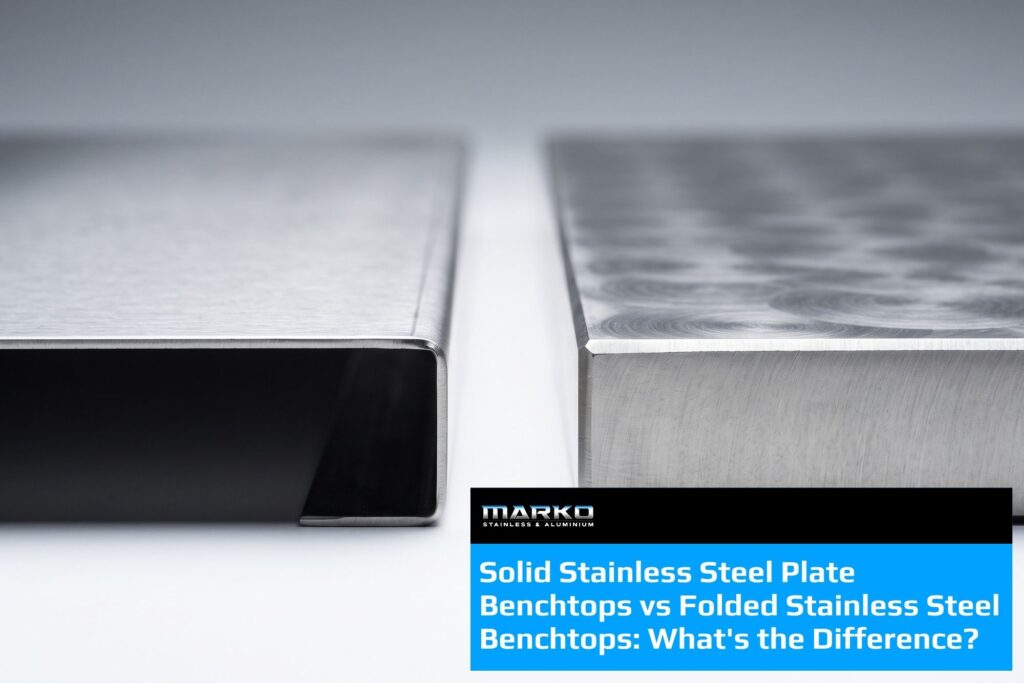
Solid plate and folded stainless steel benchtops can look similar across a room. They are made completely differently. A folded benchtop uses thin stainless sheet formed around a substrate or a supporting structure. A solid plate benchtop is fabricated from full-thickness stainless plate with no bonded substrate behind it.
Neither method wins on its own. Folded tops are practical, proven and cost-effective across a lot of commercial work. Solid plate suits projects where the exposed edge, the material character and integrated fabrication are part of the design rather than a by-product of it.
What is a folded stainless steel benchtop?
A conventional folded substrate benchtop is made from roughly 1.2 mm to 1.5 mm stainless sheet. The sheet gets cut and formed to create the working surface, the front edge, the rear upstand and the other details, then bonded to a substrate or installed over a supporting structure.
Upstands, downturns, wet edges and wall returns are all formed into the top, with the substrate or frame carrying the load underneath.
Folded tops are used across commercial kitchens, schools, healthcare facilities, laboratories and workshops. They are lighter than plate, easier to handle on most sites and more economical. Designed and installed properly, a folded top will give decades of service.
What is a solid stainless steel plate benchtop?
A solid plate benchtop is made from stainless plate rather than thin sheet bonded to something else. Marko fabricates these from 4 mm to 10 mm, with 6 mm the common choice for commercial and architectural work.
The stainless runs through the full thickness of the top, which gives you a substantial exposed edge with no bonded substrate behind it. You cannot fake that by increasing the downturn on a folded top, and anyone who works with the material can tell the difference at a glance.
Solid plate suits architectural kitchens, bars, serveries, counters and high-end commercial fitouts. Custom shapes, corners, junctions, sinks and appliance cut-outs get coordinated as one fabricated assembly.
Solid plate versus folded construction at a glance
| Feature | Folded stainless steel benchtop | Solid plate stainless steel benchtop |
| Construction | Thin sheet formed over a substrate or supporting structure | Full-thickness stainless steel plate, no bonded substrate |
| Typical thickness | About 1.2 mm to 1.5 mm sheet | 4 mm to 10 mm plate, commonly 6 mm |
| Weight | Lighter | Considerably heavier |
| Edge appearance | Formed downturn or edge profile | Genuine solid stainless steel edge |
| Common finishes | Directional brushed | Orbital or brushed |
| Cost | Generally lower | Generally higher |
| Best suited to | Practical commercial work surfaces | Architectural and design-led applications |
| End of life | Stainless bonded to another material | All stainless, recoverable and recyclable |
How do the finishes and edges differ?
A folded top usually carries a directional brushed finish. Its visible thickness comes from folding the sheet down at the front, so a 40 mm edge does not mean 40 mm of stainless steel.
A plate top shows the real material thickness at the edge. The surface can be a brushed linear grain or an orbital treatment. Orbital is currently the most requested finish for solid plate at Marko, because its non-directional pattern suits the heavier architectural form and lets everyday working marks blend in.
Pick the edge and the surface finish together. Corner radii, junctions and transitions into adjoining materials all change the result, and they are hard to revisit once the plate is cut.
What about sinks and equipment cut-outs?
Both methods take sinks, taps and equipment. The detailing is what differs.
Folded benchtops commonly include integral welded bowls, drainers, wet edges and upstands. Solid plate tops can take integral welded, undermount or top-mount sinks, along with openings for cooktops, tapware, bottle fillers, services and other equipment.
Confirm the position, model and installation requirements of every item before fabrication. Changing a cut-out afterwards is difficult and usually affects the finish around it. In food handling areas, Standard 3.2.3 of the Australia New Zealand Food Standards Code requires fixtures and equipment to be able to be cleaned effectively, which is worth reading alongside the sink detail. Check the FSANZ food safety standards against your project specification.
Does solid plate still need support?
Yes. Removing the bonded substrate does not remove the need to assess spans, loads and support locations. A 6 mm stainless benchtop is heavy, and it gets heavier with bowls or large overall dimensions.
Coordinate cabinetry, frames, brackets, wall fixings, site access and lifting early. Long tops often need dividing into transportable sections, which makes the position and treatment of site joints a design decision rather than an afterthought.
What about the end of the benchtop’s life?
This is the difference nobody raises during specification and everybody raises during a refurbishment. A folded top is stainless steel permanently bonded to another material, so recovering the steel means separating it first.
A solid plate top is stainless the whole way through. At the end of its service life it can be recovered and recycled as it stands. For clients tracking material selection and resource recovery, that is a real point of difference, and it is worth putting in the specification notes rather than leaving it for someone to discover in twenty years.
Which benchtop should you specify?
Choose folded construction when the project needs a durable, hygienic, economical work surface, particularly where formed upstands, downturns and wet edges are the priority. That still covers a large share of commercial kitchens and institutional projects.
Consider solid plate when the genuine exposed edge, the substantial feel and the architectural finish justify the extra material, fabrication, support and installation. It gets chosen where the benchtop is a design element rather than a work surface that happens to be metal.
Base the decision on intended use, dimensions, spans, loading, edge details, sinks, cut-outs, finish, access, installation and budget, not on stainless steel thickness alone.
Plan the construction method early
Choose the construction method before cabinetry, supports and service locations are locked in. Early coordination lets the benchtop, the sinks, the equipment and the surrounding joinery be designed as one system instead of three that have to be reconciled on site.
Marko Stainless & Aluminium provides custom stainless steel fabrication in Cardiff for projects across Newcastle, the Hunter, NSW and beyond. As an ASSDA accredited fabricator established in 1994, we can review drawings and help work out which construction method suits the application.
Send us your drawings to discuss a folded or solid plate stainless steel benchtop for your project.