Wash troughs, drinking troughs and art troughs share the same basic stainless steel form and do three different jobs. Wash troughs are for handwashing. Drinking troughs provide bubblers and bottle-filling points. Art troughs are built for classroom activities and cleanup involving paint, clay or plaster.
Choose on appearance or length alone and you end up with the wrong tapware, the wrong drainage or no waste treatment where you needed it. Establish the activity and the location before you specify the trough.
Quick comparison
| Trough type | Primary purpose | Typical fittings | Common locations |
| Wash trough | Shared handwashing | Taps, waste and optional splashback | Student amenities, change areas, practical activity spaces |
| Drinking trough | Drinking and bottle filling | Bubblers, bottle filler and waste | Playgrounds, covered outdoor areas, circulation spaces |
| Art trough | Washing tools and handling art materials | Taps, deeper working area, arrestor where required | Art, craft and creative learning rooms |
When should you specify a school wash trough?
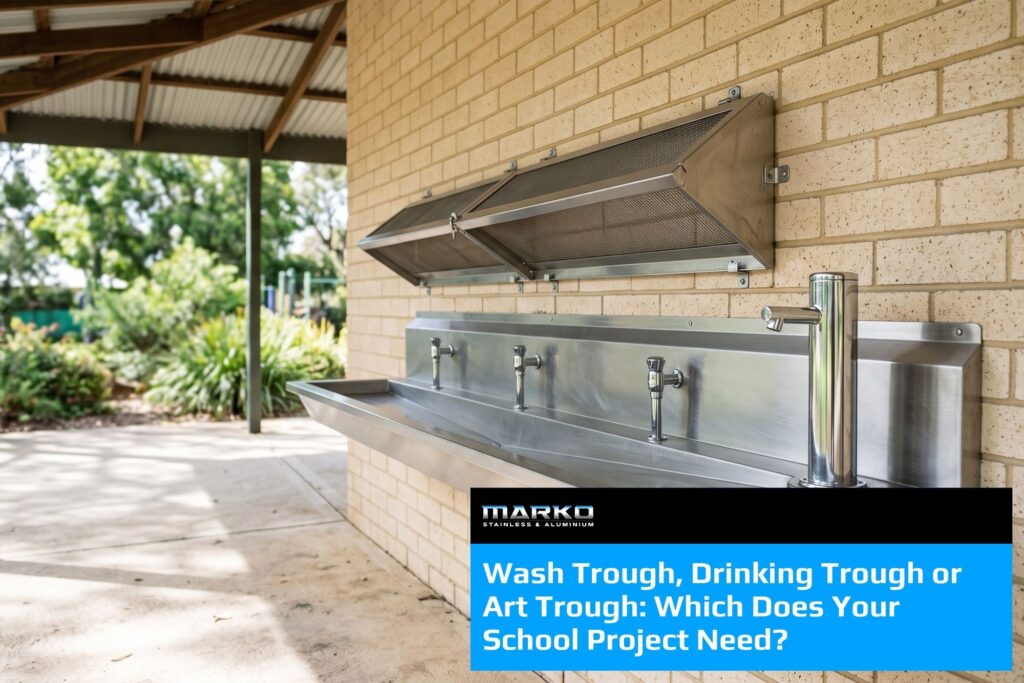
A stainless steel wash trough gives you several handwashing positions along one fixture. It suits school amenities and other high-use areas where separate hand basins would eat more wall space and need more individual plumbing connections.
Tap layout matters. Marko Stainless & Aluminium normally works to 400 mm tap centres while keeping the first and last taps around 200 mm to 300 mm from the ends where practical. A 2400 mm trough would normally carry six tap positions at 400 mm centres, with the end taps 200 mm from each end. The Wallsend pattern wash trough is the version still specified across a lot of NSW schools.
The specification should confirm:
- trough length and number of users
- tapware type, spacing and mounting
- outlet position and pre-plumbed manifold requirements
- splashback, brackets, supports and any protective guard
What makes a drinking trough different?
A school drinking trough is built around access to drinking water. It may include bubblers, bottle fillers, or a combination of both.
Bubblers need comfortable spacing between users. Bottle fillers need appropriate height and container clearance. The trough also has to collect splash and waste water without creating anywhere awkward to clean.
Current NSW School Infrastructure documentation calls for a mix of bottle fillers and bubblers, and describes one bottle filler per drinking trough as desirable. The schedule of accommodation for a large secondary school upgrade sets that out. Check the current EFSG documents and the project brief for the particular school and scope, because the ratios move with the school type and the project size.
Trough guards and after-hours security
Drinking troughs often go outdoors or into accessible circulation areas, which makes security a real consideration rather than a nice-to-have. Where a unit is exposed after hours, a lockable sloping trough guard protects the tapware and fittings.
The EFSG fabricated metalwork specification is specific about this. Guards are only to be installed on drinking and wash troughs in external or non-lockable areas. The guard must have a sloping face of roughly 45 degrees and be able to be padlocked in both the open and the closed position. Locking lugs go at both ends and must not protrude beyond the trough perimeter when the guard is locked open. Holes drilled in the trough itself for padlocks are not permitted.
The length rules catch people out. Maximum guard length is 2400 mm, and longer runs need multiple guards of equal length, so a 3000 mm trough takes two 1500 mm guards rather than one long one. Any guard over 1600 mm needs a 1.6 mm stainless steel angle stiffener to the inside front of the lid.
Marko manufactures the TG96 integral trough guard in 304 Grade No.4 stainless with a sloping top, locking in both the open and closed positions, and left, right or centre outlets. It suits the Wallsend pattern trough, with guards for other trough styles available, and powder-coated versions can be supplied. Nominate the guard at the same time as the trough rather than trying to retrofit one later.
When is an art trough required?
An art trough is a working fixture, not a handwashing basin with a longer name. It has to take brushes, containers, tools and general classroom cleanup, so a deeper or differently proportioned trough is usually more practical than a standard amenities trough.
Paint and general craft cleanup are a different problem from clay or plaster work, particularly once the waste hits the drainage system. Where solids are involved, the project may need a clay arrestor, plaster arrestor or combined unit to capture material before it reaches the pipework.
Important decisions include:
- bowl length, width and depth
- number and position of taps
- cupboard integration and working height
- waste location and accessible pipework
- materials being washed into the trough
- arrestor type, position and maintenance access
Coordinate all of that with the room layout and the hydraulic design before manufacture. An arrestor needs enough room around it for the collection components to come out and be cleaned, which is the detail most often lost when joinery gets finalised. Note that practical activities area troughs are a separate fixture again, so do not fold them into the art trough decision.
Can one trough perform more than one function?
Combination arrangements are possible, but every function has to be identified. A combined wash and drinking trough might carry taps, bubblers and a bottle filler. A classroom trough might handle general washing and art activities.
The risk is treating every long stainless fixture as interchangeable. Handwashing tap spacing does not suit bubblers. A shallow amenities trough will not contain art-room splashing. A standard waste is not an arrestor.
What should be shown on the drawings?
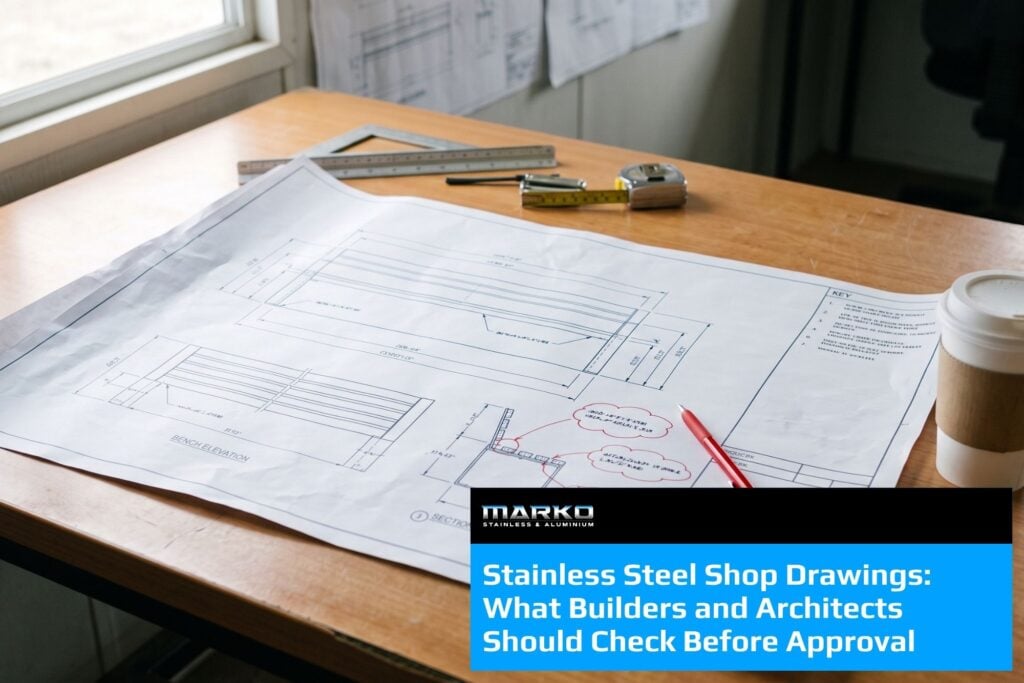
Provide the trough type, overall dimensions, mounting arrangement, tapware, outlet position and any splashback or guard. For drinking troughs, identify the bubblers and bottle fillers separately. For art troughs, nominate the materials going into the trough and whether an arrestor is required.
Frequently asked questions
Can a wash trough include a bottle filler?
Yes. Design its position, height, supply and clearance into the unit rather than adding it later without coordination.
Does every art trough need an arrestor?
No. It depends on what is going into the trough and on the hydraulic requirements. Clay and plaster waste need more thought than ordinary brush washing.
When is a trough guard required?
On NSW School Infrastructure projects, guards are specified for drinking and wash troughs in external or non-lockable areas. Check the project documents, since locations are nominated per project.
Can school troughs be custom sized?
Yes. Length, depth, tap spacing, outlets, splashbacks and mounting details can all be adjusted for the project.
Selecting the right school trough
Start with the activity: handwashing, drinking or art cleanup. Then confirm the users, the location, the tapware, the drainage, the security and the maintenance requirements.
Marko Stainless & Aluminium has manufactured stainless steel school products since 1994 and originally developed several of the trough patterns still used in education projects today. As an ASSDA accredited fabricator based in Cardiff, we supply schools, architects and builders throughout Newcastle, the Hunter, NSW and across Australia.
Talk to us about the right wash, drinking or art trough for your school project.