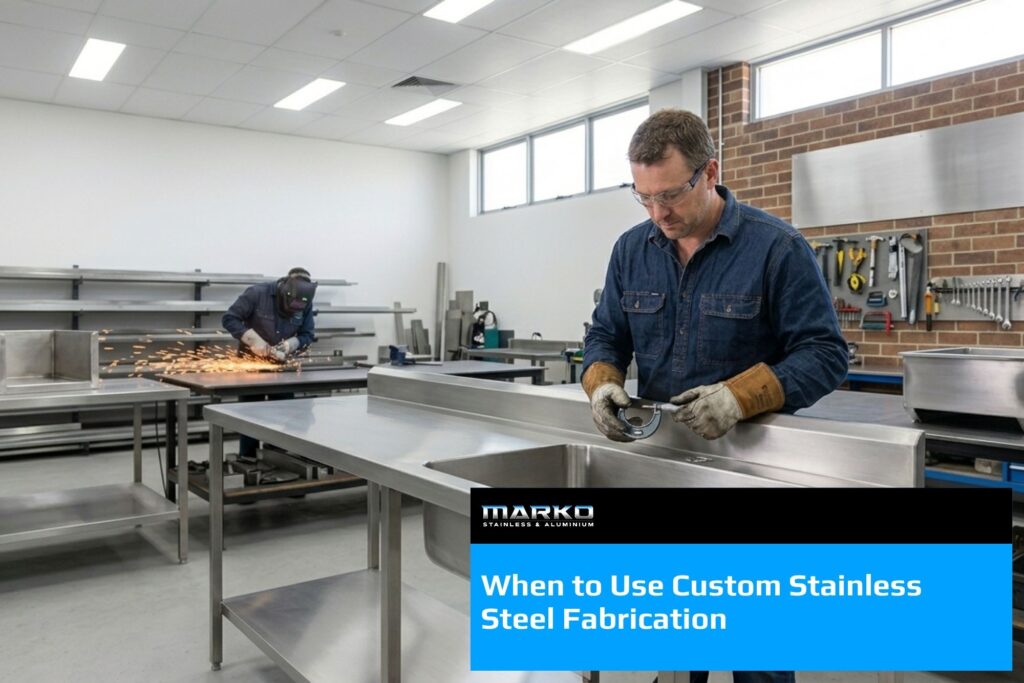
Custom stainless steel fabrication is justified when a project cannot be resolved properly with a standard product. The deciding factor is not whether custom work sounds more impressive; it is whether the site, performance requirements or surrounding construction demand dimensions and details that a catalogue item cannot provide.
For builders and architects, identifying that need early can prevent late drawing changes, compromised junctions and avoidable installation problems.
When a standard product may be adequate
A standard product can be the practical choice when its dimensions, grade, finish, mounting arrangement and service positions align with the project. It can reduce design time and may provide faster pricing or availability.
Before accepting a standard item, confirm that it does not require awkward packers, excessive site modification, relocated plumbing or changes to adjacent joinery. A catalogue dimension is only useful when it works with the complete installation.
When custom fabrication becomes worthwhile
- The available space is non-standard or must coordinate precisely with walls, columns, joinery or equipment.
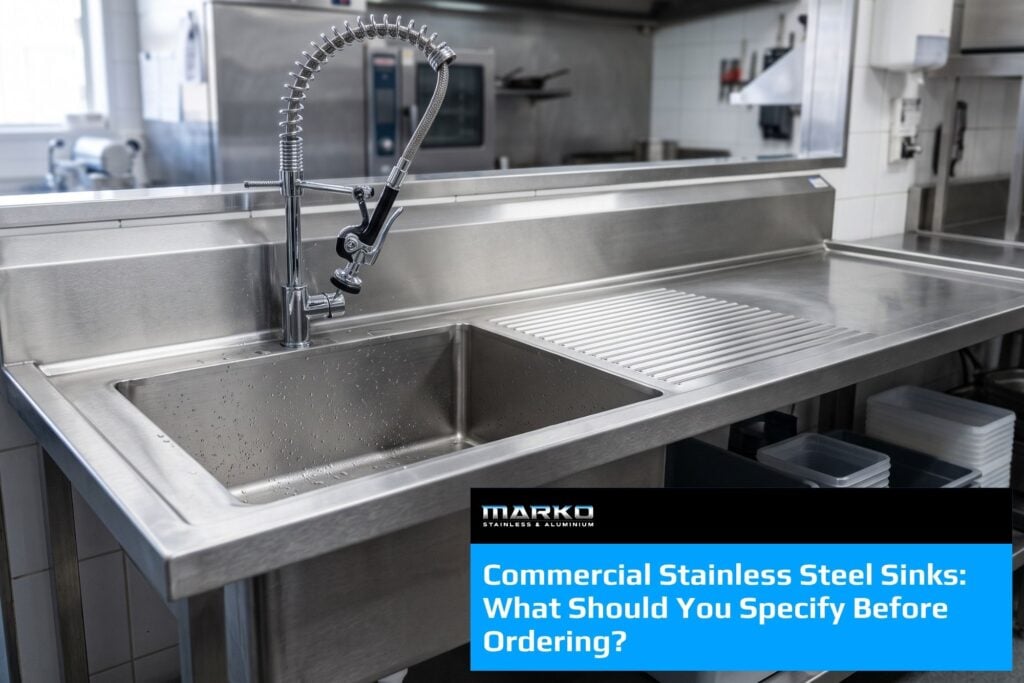
- Sink bowls, tapware, wastes, appliance cut-outs or services need project-specific positions.
- The required grade, material thickness or finish is not available in a standard product.
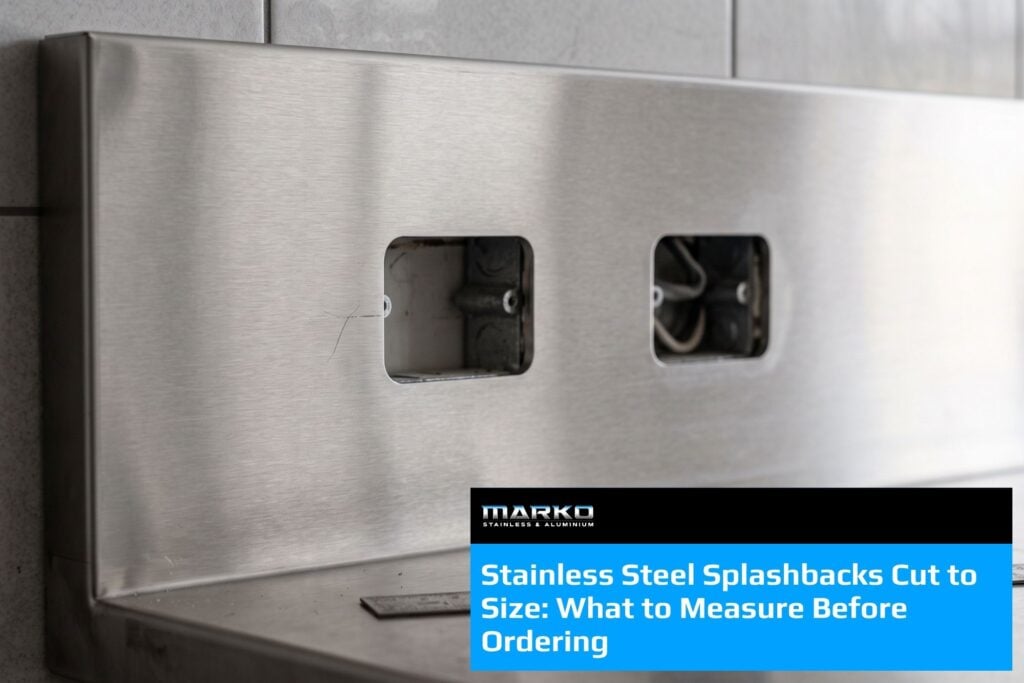
- The design needs integrated sinks, welded corners, custom upstands, splashbacks or mounting details.
- Several stainless elements must align visually and function as one coordinated fitout.
- The project documentation contains school, food-service, laboratory, public-amenity or other application-specific requirements.
Examples from current project types
| Project type | Why custom fabrication may be required |
| School food-technology rooms | Benches, sinks, splashbacks and equipment cut-outs must coordinate with joinery, teaching layouts and services |
| School science laboratories | Sink positions, bowl sizes, service penetrations and corrosion exposure may differ between rooms |
| School canteens | Counters, benches, shelving and sinks must fit a compact workflow and existing service locations |
| Council sporting-field amenities | Change rooms, canteens and toilets may require robust troughs, benches, urinals, mirrors and service coordination |
| Commercial kitchens | Bench runs, corner junctions, shelving, splashbacks and equipment positions are rarely identical from project to project |
Material grade, thickness and finish
Grade 304 is widely used for many indoor commercial applications. Grade 316 provides greater resistance to chloride-related corrosion and may be appropriate for coastal or more aggressive exposure. Grade selection should consider the actual environment, cleaning chemicals, surface finish, design and maintenance rather than relying on a single distance or indoor-versus-outdoor rule.
Material thickness is also part of the design. Traditional folded stainless steel benchtops commonly use approximately 1.2–1.5 mm sheet bonded to a suitable substrate. Solid plate benchtops are a different construction method and are commonly specified around 6 mm thick, although other thicknesses can be considered. They can incorporate integral welded sinks, undermount or top-mount sinks and equipment cut-outs.
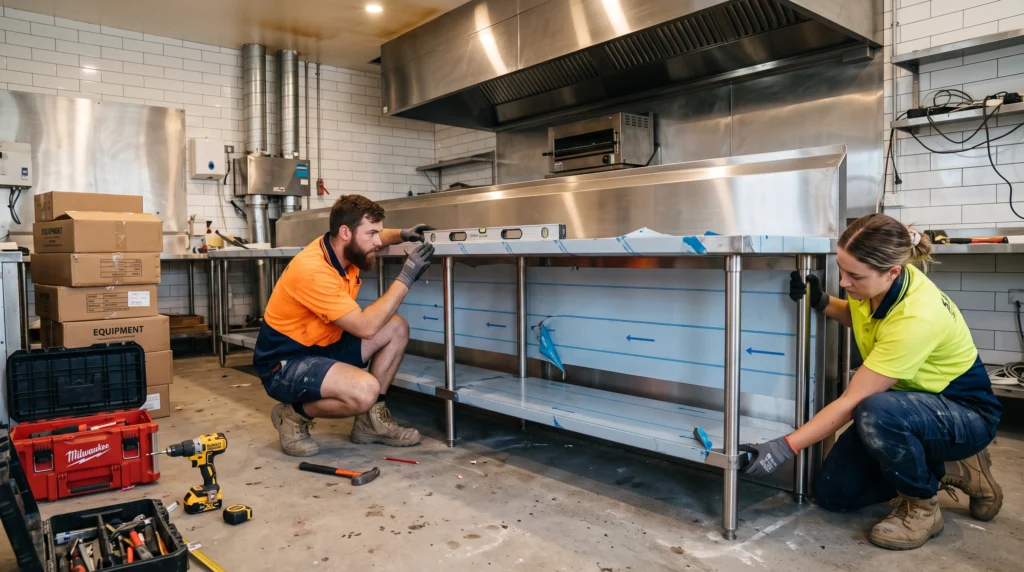
Finish should be nominated clearly. Brushed finishes are directional, while an orbital finish has a more random appearance and is currently a popular selection for Marko Stainless & Aluminium solid plate benchtops. Samples or an agreed reference finish can help avoid mismatched expectations.
Information the fabricator needs
The accuracy of the quote and shop drawings depends on the information supplied. Builders and architects should provide as much of the following as possible:
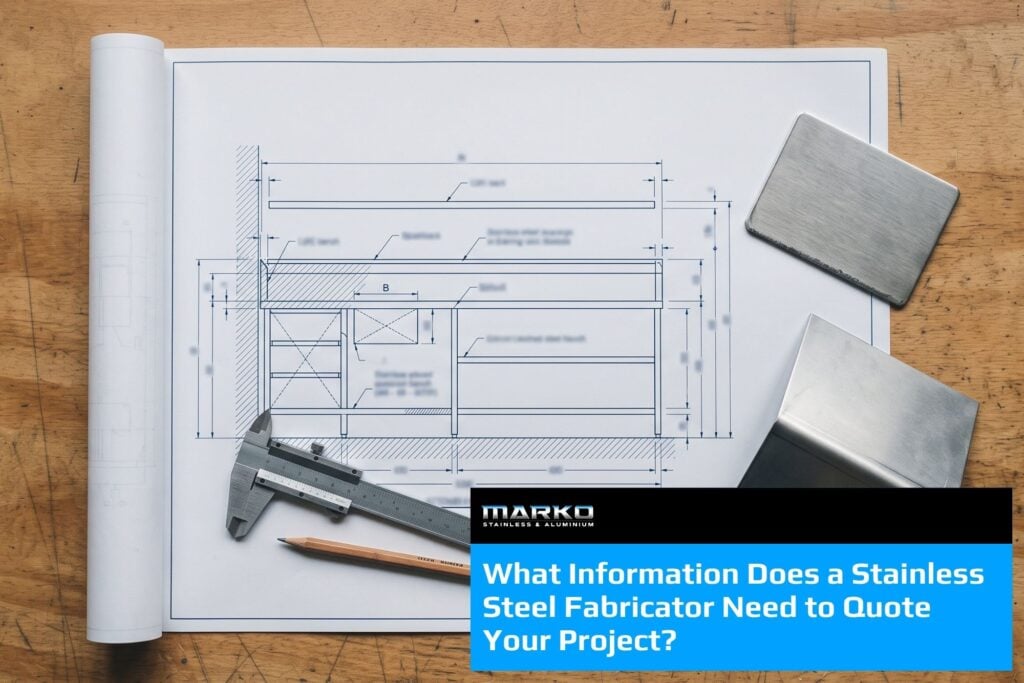
- Architectural, hydraulic, joinery and equipment drawings relevant to the item.
- Confirmed dimensions and whether they are site-verified, design dimensions or nominal only.
- The nominated stainless grade, thickness and finish.
- Sink, tapware, waste, bottle filler, appliance and service details.
- Wall, floor, substrate and mounting conditions.
- Required upstands, splashbacks, folds, edge profiles, shelves and supports.
- Delivery access, installation responsibility and programme constraints.
- Any project-specific standards, EFSG requirements, engineering or certification responsibilities.
Why shop drawings matter
Shop drawings translate the design intent into information that can be fabricated. Before approval, the builder and consultant team should check overall dimensions, service locations, sink and equipment cut-outs, junctions, fixing details, grade, thickness, finish and installation responsibility.
Approval should not be treated as an administrative step. A dimension or penetration approved incorrectly may be difficult to change after cutting, folding or welding has started.
Working with Marko Stainless & Aluminium
Marko Stainless & Aluminium has been trading since 1994 and is an ASSDA accredited fabricator. The business works with builders, architects, schools, councils and commercial clients on stainless steel products ranging from benches and sinks to wash troughs, drinking troughs, urinals, mirrors, splashbacks, shelving and solid plate benchtops.
Early discussion is particularly useful where several stainless items must coordinate across a school food-tech room, canteen, science laboratory, commercial kitchen or sporting-field amenities building.
Frequently Asked Questions
Is custom fabrication always more suitable than a standard product?
No. A standard item is appropriate when its dimensions, finish, configuration and services suit the project without compromise.
When should a fabricator become involved?
Ideally before the relevant documentation is finalised, particularly where site dimensions, equipment, services and adjoining trades must be coordinated.
Can grade 304 or 316 be specified?
Yes. The appropriate grade should be selected for the actual exposure and project requirements.
Can a custom benchtop include sinks and equipment cut-outs?
Yes. Depending on the construction method, the design can include integral welded, undermount or top-mount sinks and accurately located cut-outs.