Schools choose stainless steel bathroom fixtures because they are durable, non-porous, easy to clean and resistant to the types of impact that can crack or shatter brittle alternatives. Marko Stainless & Aluminium has fabricated stainless steel wash troughs, basins, urinals and mirrors for Australian schools since 1994, including products designed for demanding education environments.
This guide covers what actually determines whether stainless steel is the right call for a specific school project, including grade selection, EFSG alignment, retrofit options and realistic cost comparisons, not just the general case for stainless over other materials.
The Demands of School Bathrooms
School facilities place different demands on fixtures than a home or office bathroom does:
- Continuous daily use across hundreds of students per block
- Frequent cleaning with commercial-grade disinfectants and descalers
- Impact from bags, equipment and general roughhousing
- A building lifecycle that’s often measured in decades, not years
- Budget cycles that favour long asset life over low upfront cost
Domestic fixtures are not always designed for this level of use. Correctly specified stainless steel is well suited to commercial and institutional environments where durability, cleanability and repairability are important.
304 vs 316: Getting the Grade Right
Not all stainless steel is the same, and this is where a lot of school fitouts go wrong. Most inland school bathrooms are well served by 304-grade stainless steel, which handles moisture, cleaning chemicals and daily impact reliably.
316-grade stainless steel contains added molybdenum for stronger corrosion resistance. It’s the better specification for:
- Coastal or salt-exposed sites where environmental conditions increase the risk of tea-staining or chloride corrosion
- Bathrooms near swimming pools, where chlorine exposure is constant
- Facilities where chloride exposure or the specified cleaning regime requires greater corrosion resistance
Grade selection should be based on the site’s actual exposure, surface finish, orientation and planned cleaning regime. In coastal or high-chloride environments, 316 grade may provide better resistance to tea-staining and pitting than 304 grade.
Durability That Reduces Replacement Costs
Ceramic and porcelain fixtures can crack or chip under impact, while some plastic and composite products may discolour, warp or degrade depending on their material and cleaning regime. Stainless steel does not shatter like ceramic and can provide a long service life when the correct grade, finish and maintenance are specified.
Although stainless steel fixtures can have a higher upfront cost, their durability and repairability can reduce replacement frequency and disruption over the life of a facility. Whole-of-life value depends on the product, environment, installation and maintenance regime.
Hygiene and Easy Cleaning
Stainless steel has a smooth, non-porous surface that is easy to clean. Welded construction can also reduce joints and crevices where residue may collect. Cleaning products should be selected in accordance with the stainless steel grade, finish and product-care instructions, with chloride-rich cleaners and abrasive scourers avoided unless specifically approved.
Safer for Students
Ceramic fixtures shatter into sharp fragments on impact. Stainless steel doesn’t, which matters in a shared space used by primary and secondary students throughout the day. Stainless steel mirrors offer the same visual function as glass without the shatter risk, an important consideration in high-traffic corridors and change rooms.
Vandal Resistance and Retrofits
Stainless steel resists impact and does not shatter like ceramic, making it suitable for many high-traffic public and education facilities. Retrofitting may be possible, but the existing plumbing, supports, wall construction, clearances and fixture dimensions must be checked for each project before a replacement is specified.
Stainless Steel Fixtures Commonly Used in Schools
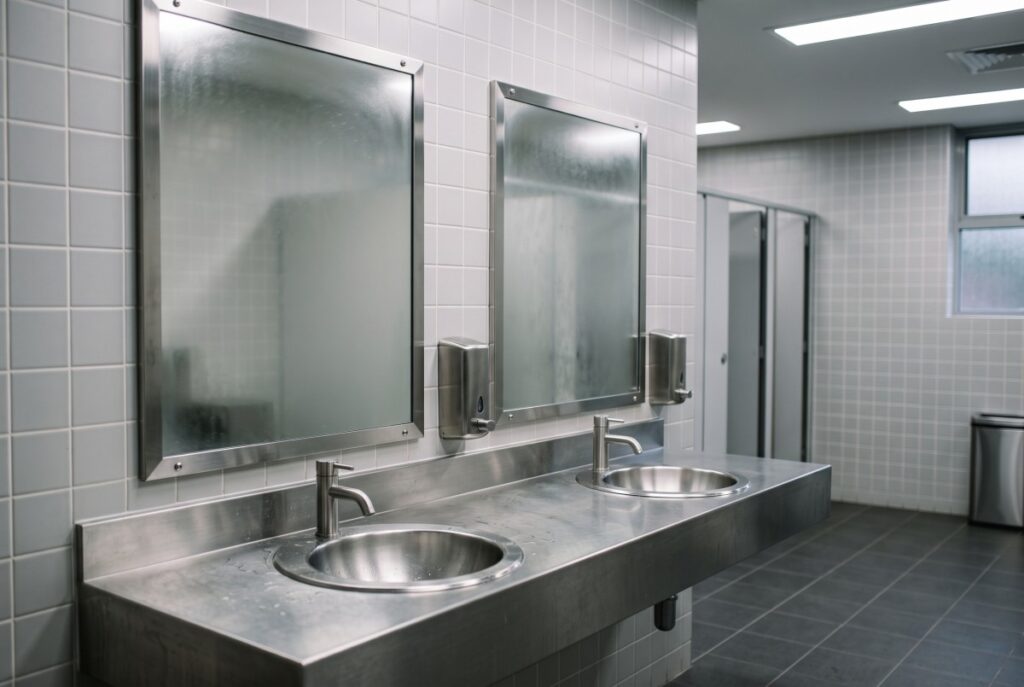
- Wash troughs for high-capacity handwashing in busy corridors
- Hand basins for compact spaces and accessible bathrooms
- Urinals and cisterns for durability and low maintenance
- Mirrors for vandal and shatter resistance
- Splashbacks, grates and bump rails to protect surrounding surfaces from the same wear that fixtures face
Designed for Education Facilities and EFSG Alignment
Our stainless steel school bathroom fixtures can be fabricated to suit the Educational Facilities Standards and Guidelines (EFSG) used on NSW school infrastructure projects. Project-specific accessibility, sizing, layout and services requirements should be confirmed from the applicable documentation before manufacture.
Long-Term Value for Schools
Stainless steel fixtures typically cost more upfront than ceramic or plastic equivalents, but the total cost of ownership tends to favour stainless once you factor in replacement frequency, maintenance labour and disruption to school operations. For education departments managing fitouts across multiple campuses, a consistent stainless specification also simplifies procurement and maintenance planning across the portfolio.
Key Stats and Data
The following material facts provide useful context for grade selection and cleaning requirements.
| Stat | Detail and source |
| 304 grade composition | Approximately 18% chromium and 8% nickel, forming the passive layer that resists everyday corrosion and staining. |
| 316 grade composition | Adds roughly 2 to 3% molybdenum on top of the 304 formula, which is what improves resistance to salt air and chloride exposure in coastal or poolside settings. |
| Surface hygiene behaviour | Stainless steel is not inherently antimicrobial the way copper is. Its hygiene benefit comes from a non-porous, seamless surface that is easy to clean thoroughly, not from killing bacteria on contact. |
Stainless Steel vs Ceramic vs Plastic: Side by Side
The comparison below provides general guidance only. Performance varies with product quality, installation, use, exposure and maintenance.
| Factor | Stainless steel | Ceramic / porcelain | Plastic / composite |
| Impact resistance | High. Dents rather than shatters. | Low. Cracks and chips under impact. | Moderate. Can crack or warp under force. |
| Chemical cleaning tolerance | High with correct grade and non-chloride cleaners. | Moderate. Glaze can dull over time. | Low. Degrades and discolours with repeated chemical exposure. |
| Upfront cost | Higher. | Lower to moderate. | Lowest. |
| Total cost of ownership | Can be lower over the building lifecycle where durability reduces replacement and disruption. | Depends on product quality, use and replacement frequency. | Depends on material quality, use and replacement frequency. |
| Failure mode safety | Deforms rather than shattering into brittle fragments. | Shatters into sharp fragments. | Can crack into sharp-edged pieces. |
Why Choose Marko Stainless & Aluminium
- Trading since 1994, with direct experience across school, healthcare and commercial fitouts
- Australian-made stainless steel products, fabricated in-house
- ASSDA Accredited Fabricator
- Products available direct from Marko Stainless & Aluminium and through selected plumbing suppliers
- Custom sizing and configuration for EFSG and site-specific requirements
Conclusion
For durability, hygiene, safety and long-term value, stainless steel remains the preferred material for school bathrooms, provided the grade and specification are matched to the site. Getting that right at the design stage, rather than after a coastal school’s fixtures start tea-staining, is where the real value of working with an experienced fabricator shows up.
Contact Marko Stainless & Aluminium today to discuss stainless steel bathroom solutions for your school or education facility.
Frequenty Asked Questions
Does a coastal school need a different stainless steel grade than an inland school?
Coastal exposure can require a different grade and maintenance approach. Grade 316 generally provides better resistance to salt and chloride exposure than grade 304, but the final selection should consider the site’s exposure, finish, orientation and planned cleaning regime rather than relying on a fixed distance from the ocean.
Can stainless steel fixtures be retrofitted into an existing bathroom, or does the whole space need to be rebuilt?
Stainless steel fixtures can sometimes be retrofitted, but this must be assessed for each project. Existing plumbing rough-ins, supports, wall construction, clearances and the new fixture dimensions should all be checked before ordering.
How long does a stainless steel bathroom fitout take, from order to installation?
Lead times depend on the complexity of the fixture and whether it’s a standard product or a custom configuration to EFSG dimensions. Standard wash troughs and basins typically have shorter lead times than fully custom runs. Get in touch with your project details for a specific timeline.
Are there cleaning products that damage stainless steel fixtures over time?
Chloride-rich cleaners and abrasive scourers can contribute to pitting, scratching or staining. Use non-abrasive products that are compatible with the selected stainless steel grade and finish, follow the cleaner manufacturer’s directions and rinse residues thoroughly.
Is stainless steel more expensive than ceramic or plastic fixtures for a school bathroom?
Upfront cost may be higher than some ceramic or plastic alternatives. Stainless steel can offer strong whole-of-life value where durability, repairability, cleaning and reduced replacement disruption are important, although the outcome depends on the project and maintenance regime.
Do stainless steel bathroom fixtures need to meet EFSG or state education infrastructure guidelines?
Where a NSW project is governed by EFSG requirements, the applicable dimensions, accessibility provisions, services and layout rules should be confirmed from the project documentation. Custom fabrication can help meet requirements that are not available in standard catalogue sizes.
Is stainless steel a sustainable choice for school infrastructure?
Stainless steel is fully recyclable at end of life and its long service life reduces the volume of replacement fixtures going to landfill over a building’s lifecycle, compared to materials that need periodic replacement.