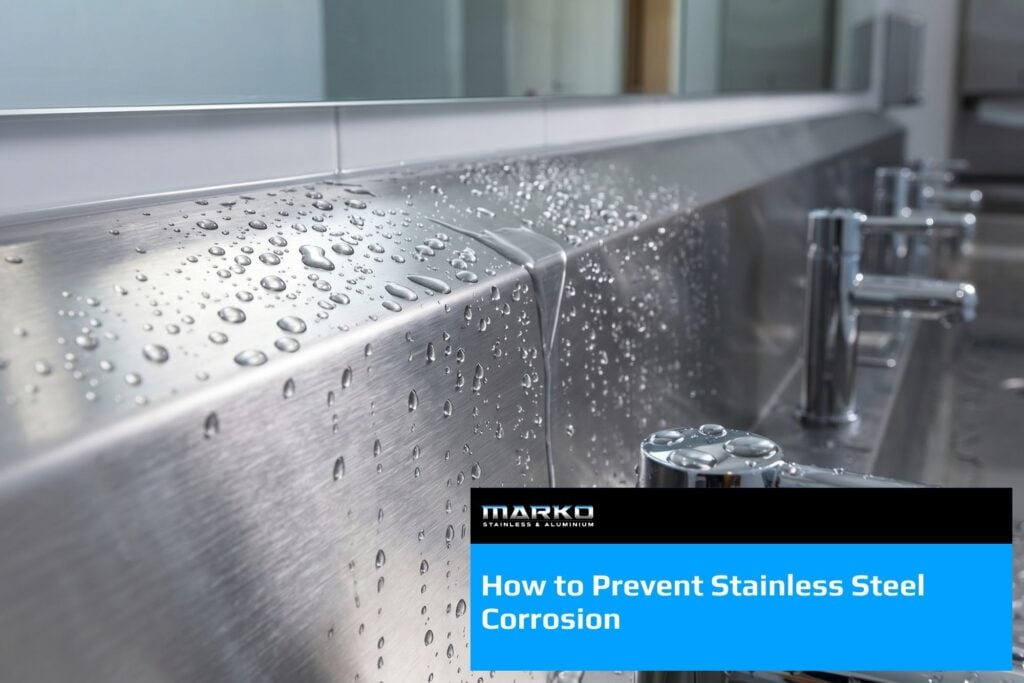
One of the biggest reasons people choose stainless steel is its reputation for durability and corrosion resistance. But while stainless steel performs extremely well in demanding environments, it is not indestructible. If the wrong grade is selected, poor design is used, or maintenance is neglected, even stainless steel can show signs of corrosion over time.
That is why understanding how to prevent stainless steel corrosion is so important. At Marko Stainless & Aluminium, we fabricate stainless steel products for schools, workplaces, public facilities, and commercial environments, and we know that long-term performance depends on more than just the material itself. Good results come from the right combination of grade selection, fabrication quality, design, and care.
Why Stainless Steel Corrodes
Stainless steel resists corrosion because of the thin passive layer that forms naturally on its surface. This protective layer helps shield the metal underneath. However, certain conditions can damage or overwhelm that layer, increasing the risk of staining, pitting, or corrosion.
Common causes include:
- using the wrong grade for the environment
- chloride exposure from salt or harsh cleaning chemicals
- trapped moisture and poor drainage
- contamination from carbon steel or dirty tools
- lack of routine cleaning in exposed areas
In many cases, corrosion issues are not caused by stainless steel being the wrong material, but by it being used or maintained incorrectly.
Start With the Correct Grade
One of the most effective ways to prevent corrosion is to choose the right stainless steel grade from the beginning.
As a practical guide:
- 304 stainless steel is often suitable for many internal and lower-exposure applications
- 316 stainless steel is often the better choice for coastal, exposed, wet, or more aggressive environments
Choosing the correct grade is one of the most important decisions in corrosion prevention. A product that performs well indoors may need a different specification outdoors or near the coast.
Good Design Helps Prevent Corrosion
Corrosion prevention is not only about material choice. The design of the product also matters.
Good stainless steel design helps:
- avoid water traps
- encourage drainage
- minimise dirt and salt build-up
- reduce hidden crevices
- improve cleanability
A poorly designed product can hold moisture and contaminants in areas that are hard to clean, increasing the risk of corrosion over time.
Surface Condition Matters
The quality of the finished stainless steel surface has a direct impact on long-term performance. Clean, properly finished stainless surfaces are easier to maintain and less likely to trap contaminants.
This is one reason fabrication quality is so important. Well-executed stainless steel fabrication helps reduce:
- rough weld areas
- surface contamination
- hard-to-clean details
- finish inconsistencies
In short, the way stainless steel is fabricated affects how well it will perform later.
Avoid Carbon Steel Contamination
One of the less obvious causes of corrosion is contamination from carbon steel. If stainless steel is handled with dirty tools, stored incorrectly, or exposed to steel grinding dust, the surface can become contaminated and corrosion may appear.
This is why quality fabricators take care with:
- tool separation
- workshop practices
- storage
- handling
Preventing contamination during fabrication is a key part of preventing corrosion after installation.
Cleaning Is Part of Corrosion Prevention
A common misconception is that stainless steel never needs cleaning. In reality, routine cleaning is one of the best ways to maintain its corrosion resistance.
Cleaning helps remove:
- salt deposits
- dirt
- grease
- airborne contaminants
- cleaning chemical residue
This is particularly important in:
- coastal environments
- public amenities
- food preparation spaces
- outdoor school and workplace installations
The better the cleaning routine, the better the long-term performance.
Harsh Environments Need More Attention
Some environments naturally place more stress on stainless steel than others.
Higher-risk environments include:
- outdoor exposed areas
- coastal locations
- wet amenities
- commercial kitchens
- wash-down zones
- industrial workplaces
In these settings, corrosion prevention should be built into the project from the start through proper grade selection, design, fabrication, and maintenance planning.
What Corrosion Prevention Looks Like in Practice
To reduce the risk of corrosion, a project should usually include:
- the right grade for the environment
- a practical and drainable design
- clean fabrication practices
- quality surface finishing
- routine cleaning once installed
The strongest results come when all of these elements work together.
Why Choose Marko Stainless & Aluminium?
- Practical corrosion prevention advice: Guidance based on real operating environments
- Correct grade selection: Stainless steel specified to suit the level of exposure
- Quality fabrication practices: Better finishes, cleaner construction, and stronger long-term performance
- ASSDA accredited fabricator: Confidence in stainless steel knowledge and workmanship
- Established since 1994: Proven experience delivering durable stainless steel solutions
Conclusion
If you want to understand how to prevent stainless steel corrosion, the key is to think beyond the material alone. The right grade, sound design, clean fabrication, and regular maintenance all play a role in long-term performance.
When these factors are handled properly, stainless steel remains one of the most durable and reliable materials available for schools, public facilities, workplaces, and commercial projects.
Call to Action
Contact Marko Stainless & Aluminium to discuss stainless steel solutions designed for long-term corrosion resistance and project durability.
FAQ – Preventing Stainless Steel Corrosion
Can stainless steel still corrode?
Yes. Stainless steel is highly corrosion resistant, but the wrong grade, poor design, contamination, or lack of cleaning can still lead to corrosion.
Is 316 always better than 304 for corrosion prevention?
Not always. 316 is often better in coastal or more aggressive environments, but 304 is often suitable for many internal and lower-exposure applications.
Does stainless steel need cleaning to stay corrosion resistant?
Yes. Routine cleaning helps remove contaminants such as salt, dirt, and residue that can affect long-term performance.