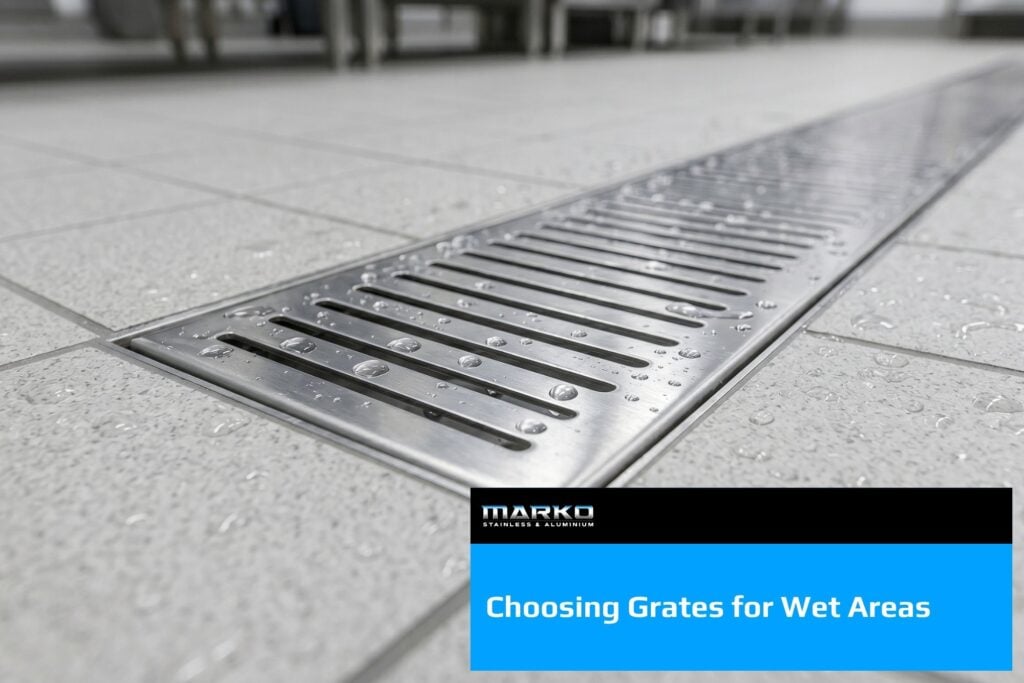
Grates may seem like a small detail in a wet area, but they play a major role in drainage performance, hygiene, safety, and long-term maintenance. In schools, commercial kitchens, workplaces, and public amenities, choosing the wrong grate can lead to blocked drains, poor water flow, difficult cleaning, and unnecessary wear.
At Marko Stainless & Aluminium, we fabricate stainless steel grates for a wide range of wet areas. Knowing how to choose the right grate means looking beyond appearance and thinking about water volume, traffic, safety, cleaning, and the overall function of the space.
The best grate is not simply the one that fits the opening , it is the one that suits the environment it is being used in.
Why Grate Selection Matters
A grate is the visible part of the drainage system, but it affects much more than appearance.
The right grate for a wet area helps:
- improve water capture
- reduce pooling
- support safer foot traffic
- simplify cleaning
- protect the drainage channel below
- improve long-term maintenance outcomes
In high-use spaces, poor grate selection can quickly become an ongoing maintenance issue.
Start With the Type of Wet Area
The first thing to consider is the environment.
Different wet areas place different demands on the grate. For example:
- a school change room needs different grate performance to a commercial kitchen
- a cleaners’ room differs from a public bathroom
- a food preparation area may need more attention to hygiene and cleanability
- a workplace service area may need stronger load resistance
The way the space is used should guide the grate selection from the start.
Think About Water Volume
One of the most practical questions is: how much water needs to be managed?
A grate in a light-use amenity area may only need to handle occasional water flow. But in a commercial kitchen, wash-down zone, or larger wet area, the grate needs to cope with much higher volumes.
Choosing the wrong grate for the water load can lead to:
- slow drainage
- water pooling
- increased cleaning effort
- reduced safety
This is why the grate should always be selected as part of the broader drainage design, not as an afterthought.
Consider Foot Traffic and Load
Grates in wet areas are often walked on constantly. In some spaces they may also be exposed to trolleys, carts, bins, or cleaning equipment.
A suitable stainless steel grate should match the expected traffic level. In busier environments, stronger construction and practical grate design become more important.
This is especially relevant in:
- school amenities
- public bathrooms
- food preparation areas
- cleaners’ rooms
- service corridors
The grate should be durable enough to cope with real use, not just light-traffic assumptions.
Safety Is a Major Factor
In wet areas, safety matters. The grate should support confident movement through the space and help minimise trip or slip risks.
Important considerations include:
- how the grate sits in the floor
- whether the profile suits the location
- whether the grate design supports safe practical use underfoot
- how well it works with the surrounding floor finish
A strong grate choice supports both drainage performance and a safer environment.
Hygiene and Cleanability
Wet areas need to be cleaned properly, and grate selection plays a part in how easy that is.
In schools, commercial kitchens, and public amenities, a good grate should:
- allow water to flow efficiently
- avoid trapping excess debris
- be easy to remove or access if needed
- suit routine cleaning practices
Stainless steel grates are often preferred because they offer:
- good corrosion resistance
- easy cleaning
- strong durability
- compatibility with wet-area environments
This is one reason stainless steel remains a preferred material for many drainage applications.
Standard vs Custom Grates
Some projects can use standard grate profiles, but many benefit from custom stainless steel grate fabrication.
Custom fabrication allows for:
- exact sizing
- better fit with the drainage channel
- improved coordination with surrounding finishes
- stronger detailing for the intended use
- consistency across larger fitouts
At Marko Stainless & Aluminium, grates can be fabricated to suit the actual wet area rather than relying on a generic product that may only partly fit the job.
Match the Grate to the Full Drainage System
A grate should never be selected in isolation. It needs to work with:
- the drain below
- the floor layout
- the expected water load
- the maintenance requirements of the space
The best results come when the grate is considered as part of a complete drainage solution rather than as a separate item.
Why Choose Marko Stainless & Aluminium?
- Practical grate selection advice: Guidance based on how the wet area will actually be used
- Custom fabrication capability: Stainless steel grates made to suit exact project requirements
- Experience across schools, workplaces, kitchens, and public amenities: Real-world understanding of wet-area performance, including products suited to EFSG-related school applications
- ASSDA accredited fabricator: Confidence in stainless steel workmanship and quality
- Established since 1994: Proven experience delivering durable stainless steel solutions
Conclusion
Choosing the right grate for a wet area is about more than appearance. The best grate is one that suits the water volume, traffic, safety needs, and maintenance demands of the environment.
For schools, workplaces, kitchens, and public amenities, stainless steel grates provide a durable and practical solution that supports better drainage performance over the long term.
Call to Action
Contact Marko Stainless & Aluminium to discuss the right stainless steel grates for wet areas on your next project.
FAQ – Choosing Grates for Wet Areas
What is the most important factor when choosing a grate for a wet area?
The most important factor is how the area will actually be used, including water volume, traffic, and cleaning requirements.
Are stainless steel grates better for wet areas?
In many cases, yes. Stainless steel grates offer strong durability, corrosion resistance, easy cleaning, and long-term performance.
When should you choose a custom grate instead of a standard one?
A custom grate is often the better choice when the layout is unusual, traffic is heavier, or the drainage system needs to integrate closely with surrounding finishes.